A Chess Champ at Age 8

A young boy sits behind a chess board that has been set up for a game.

A Chess Champ at Age 8

Ashwath Kaushik is the youngest person ever to defeat a chess grandmaster.

A young boy sits behind a chess board that has been set up for a game.

Carleton Lim/Singapore Chess Federation

Ashwath Kaushik says he hopes to become a world chess champion.

Like many 8-year-olds, Ashwath Kaushik likes bike riding, LEGO, and hanging out with his friends. He also likes chess—and he’s really good at it. On February 18, Ashwath became the youngest person ever to defeat a chess grandmaster.

In the game of chess, grandmasters are considered the very best. It’s not easy to defeat one. Ashwath’s victory opposite grandmaster Jacek Stopa, 37, took place at a chess tournament in Switzerland. Only one other 8-year-old had defeated a grandmaster before, and he was five months older than Ashwath.

“I feel proud of my game and how I played. I felt amazing, just unbelievable,” Ashwath told CNN.

Ashwath started playing chess when he was 4 years old. He learned the game with help from a website called ChessKid. Before long, he was playing on a chess board against family members and winning. Today, Ashwath has a chess coach and some big dreams. What’s his goal?

“[I want to be] a world champion,” he told CNN. “That will be a bit of time. It won’t come quickly.”

“I practice a lot each day,” Ashwath said. “A lot of children have a natural talent, so I think I’ve got a natural talent at chess.”

Face Thinking Icon

Did You Know?

A man moves a piece on a chess board as another man watches and types into a computer.

© Tom Mihalek—AFP/Getty Images

Garry Kasparaov (left) played chess against a computer called Deep Blue in 1996.

In 1996, chess grandmaster Garry Kasparov won a chess match against Deep Blue, a computer that IBM had designed to play chess.

Today, computers have gotten so advanced that experts say it would be hard for a human to defeat one in a chess match!

Happy Pi Day!

Did you know that March 14 is Pi Day? Pi is a number with many digits. Most people shorten pi to 3.14. Since you can write March 14 as 3/14, people celebrate this day as Pi Day!

Pi is sort of a magic number when it comes to circles. Check this out.

Let’s say you draw a circle. If you measure around the circle, you get its circumference. If you measure across the circle is at its widest point, you get its diameter.

Two wheels of Swiss cheese, one showing circumference and the other showing diameter with a mouse on either side.

© Catherine Douglas/Dreamstime.com; Composite illustration Encyclopædia Britannica, Inc.

If you divide the circumference of a circle by the diameter of the circle, you get a number that’s very close to 3.14. 

Let’s try it. Below, we have some cheese that’s shaped like a circle. Its circumference is 15.7 inches. Its diameter is 5 inches. If we divide 15.7 by 5, we get 3.14!

© Catherine Douglas/Dreamstime.com; Composite illustration Encyclopædia Britannica, Inc.

You can do this with any circle. You will always get a number that’s very close to 3.14.

All this math is making us hungry! The good news is that people have an amazing way to celebrate Pi Day. They eat pie!

Every Move Counts

LeBron James has jumped into the air and is about to dunk a basketball as two opponents look on behind him.

Kevin C. Cox/Getty Images Sport

Chess is a game that requires players to plan their moves in order to achieve the goal of winning. Basketball is the same. In fact, many people have said that LeBron James is like a chess player on the basketball court! Do you agree?

You can read more about LeBron James at Britannica.

Word of the Day Icon

Word of the Day

strategy

Part of speech:

noun
Definition:

: a careful plan or method for achieving a particular goal usually over a long period of time

Definitions provided by
Merriam-Webster Logo
Game Icon

Play

Crossword

Answer the clues to fill in the puzzle.

O
O
O
O
O

In Case You Missed It

Mycelium grows fast, making it a great building material.
June 9, 2026
Farmers get annoyed when elephants eat their crops. But it’s possible the elephants understand that certain plants are great medicine.
June 4, 2026
Krista Richard fixes up old bikes and gives them to children.
June 2, 2026
Chinese workers helped build a railroad that stretched across the United States and changed the country.
May 28, 2026

Disney Imagineer Is a Top Inventor

Lanny Smoot stands on a platform in front of a sign reading Disney Research.

Disney Imagineer Is a Top Inventor

As an imagineer, Lanny Smoot helps make Disney’s parks and attractions awesome.

Lanny Smoot stands on a platform in front of a sign reading Disney Research.
© Disney
Disney imagineer Lanny Smoot stands on the HoloTile Floor, which he invented.

When Lanny Smoot was about 5 years old, his dad brought home a light bulb, a bell, batteries, and wire. Smoot watched, amazed, as his dad put those things together in a way that made the bulb light up and the bell ring. He decided he wanted to see what he could make. Today, Smoot is a Disney imagineer—an inventor who has created some of Disney’s most incredible attractions.

Smoot’s journey to becoming an imagineer started soon after he saw that bulb light up. At school, he loved science class, and he entered every science fair there was. At home, he started taking things apart to see how they worked. He also started building new things from whatever materials he could find. He even put together a unicycle using a bike seat and part of a tricycle. (He can still ride a unicycle!) Eventually, Smoot went to college and studied engineering. An engineer is a person who designs complicated products, machines, systems, or structures. He became a Disney imagineer in 1998.

Lanny Smoot leans down and manipulates a device while surrounded by many computers and other types of technology.
© Disney
Lanny Smoot shows some of the equipment he uses in his work.

Disney imagineers are responsible for designing and building features for Disney’s theme parks, merchandise, and games. Smoot’s list of inventions is long. He created the technology that makes it possible for Madame Leota to “float” at Disneyland’s Haunted Mansion. His “water harp,” located at Epcot Center in Florida, is a series of water “strings” that play musical notes when people run their hands through it.  Smoot also invented the lightsabers that were used in Disney’s Star Wars: Galactic Starcruiser attraction.

“I love to create,” Smoot told CNN. “I love to come up with inventions…[I just want] to make good things that will amaze and enchant people.” 

In May, Smoot will be inducted to the National Inventors Hall of Fame. He said he hopes this inspires young people to become scientists and engineers.

“I believe that every person has a special talent, sometimes multiple talents,” he said in an article on the National Hall of Fame website. “I would love to see a world that exposes more life choices to all people so that their natural talents can bloom.”

Face Thinking Icon

Did You Know?

Speech bubbles pop up on a photo of Disney World, saying it smells like popcorn, candy, and royalty.
© Viavaltours/Dreamstime.com; Animation Encyclopædia Britannica, Inc.

Disney theme parks use machines called “Smellitizers” to pump different scents all over the parks. Visitors might smell the ocean on a ride that takes them on a long voyage. Near the candy shop, they might catch the scent of vanilla. Disney says the Smellitizers help make the Disney experience more complete.

The Top Ten…

Great Ideas

A collage shows various inventors from the past and present.

North Wind Picture Archives, © PictureLux—The Hollywood Archive/Alamy, Addison N. Scurlock—Michael Ochs Archives, Bettmann/Getty Images, UPI/Bettmann Archive, NASA, Library of Congress (LC-USZ62-65195), National Portrait Gallery (NPG.87.43), Wellcome Collection, London; Photo composite Encyclopædai Britannica, Inc.

Think of an object in the room where you are right now. What would life be like if that object had never been invented?

You can read about inventions and inventors at Britannica!

Word of the Day Icon

Word of the Day

devise

Part of speech:

verb

Definition:
: to invent or plan (something that is difficult or complicated)
Definitions provided by
Merriam-Webster Logo
Game Icon

Play

Criss Cross

Can you figure out where all the words go?

O
O
O
O
O

In Case You Missed It

Mycelium grows fast, making it a great building material.
June 9, 2026
Farmers get annoyed when elephants eat their crops. But it’s possible the elephants understand that certain plants are great medicine.
June 4, 2026
Krista Richard fixes up old bikes and gives them to children.
June 2, 2026
Chinese workers helped build a railroad that stretched across the United States and changed the country.
May 28, 2026

Go, Coco!

Coco Gauff stands on a tennis court holding up a racket and poised to hit a ball.

Go, Coco!

At age 19, Coco Gauff is one of the world’s top tennis players.

Coco Gauff stands on a tennis court holding up a racket and poised to hit a ball.

Robert Prange/Getty Images Sport

Coco Gauff has a bright future.

Coco Gauff just had a very good year. In 2023, the 19-year-old Gauff won the U.S. Open, which is one of the world’s four major tennis championships. Many people believe Gauff could become one of the greats in her sport.

Gauff’s rise in her sport has been slow and steady. She won some junior tennis titles as a kid, and pretty soon she was playing in major tournaments (tennis events) against some of the players she has always looked up to. In June 2019, Gauff had a chance to play at Wimbledon, a major tournament in England. Only 15 at the time, she played against the great Venus Williams—and won that round.

Since then, Gauff has had a chance to spend time with Venus and her tennis-star sister, Serena. She says the sisters are serious on the tennis court, but they know how to relax too.

“They’re goofy, fun people. That’s the coolest part,” Gauff told the Guardian. “They taught me you could be yourself and still be intense on court.”

Later in 2019, Gauff took part in the U.S. Open and found herself out of the contest when she lost a match against top tennis player Naomi Osaka. She was frustrated and upset. But at 16, she’d made it to the third round of one of the biggest events in her sport. It was a big deal. Gauff played against Osaka again, at the 2020 Australian Open. She won the match.

Gauff’s 2023 U.S. Open victory is her first win in a major tennis event—and her steady improvement suggests it won’t be the last.

Meanwhile, Time magazine sees a bright future for Gauff. The publication named Gauff as one of its 10 Women of the Year for 2024. The list is made up of what Time calls “extraordinary leaders.” Tennis talent isn’t the only reason Gauff made the list. She often speaks out on issues she cares about, such as climate change and equal rights for all.

NEWS EXTRA!

Making Time for Fun

Coco Gauff smiles and pretends to play a tiny toy guitar.

Robert Prange/Getty Images Sport

Like the Williams sisters, Coco Gauff makes sure to have fun off the tennis court. She’s a big fan of Marvel comics. She also loves Beyoncé. In 2023, while traveling to play in different tennis events in Europe, Gauff went to a Beyoncé concert and had the time of her life.

“She was amazing!” Gauff told the Guardian. “She didn’t wave at me from the stage, but I’m going to say she did.”

Fun Fact Icon

Fun Fact

A king and three knights play tennis with their bare hands in front of a castle.

© Designvectorpro, Ernest Akayeu/Dreamstime.com, © yusufdemirci/stock.adobe.com; Animation Encyclopædia Britannica, Inc.

Tennis dates back to a game played in the 1100s or so. Back then, players hit the ball with their bare hands!

Top of Their Sports

Wally McNamee—Corbis Historical, Focus on Sport, Quinn Rooney—Getty Images Sports, Hulton Archive—Archive Photos/Getty Images, Ed Kellinovsky/AP Images; Photo composite Encyclopædia Britannica, Inc.

Clockwise from top left: Dawn Fraser, Serena Williams, Nadia Comăneci, Babe Didriksen, and Jackie Joyner-Kersee.

March is Women’s History Month. To celebrate, we’re listing some women who reached the top of their sports. We had a tough time picking only five athletes to write about! Who is your favorite woman in sports?

Dawn Fraser
Sport: Swimming
Country: Australia

Dawn Fraser was the first woman to win gold medals in swimming at three Olympic games in a row (1956, 1960, and 1964). Fraser also broke the women’s world record for the 100-meter freestyle race nine years in a row. In 1964, she swam that race in 58.9 seconds. Her record wasn’t broken until 1972.

Serena Williams
Sport: Tennis
Country: United States

Many people believe Serena Williams is the best tennis player of all time. Some even say she’s the best athlete ever. Why? During her career, Williams won 23 major tennis tournaments (called Grand Slam titles) as a singles player. She won 14 as a doubles player, teaming up with her sister, Venus. Williams won her last Grand Slam title in 2017 at the record age of 35 years, four months, and two days—and she was pregnant at the time. Williams also has four Olympic gold medals, which she won at the 2000, 2008, and 2012 games.

Nadia Comăneci
Sport: Gymnastics
Country: Romania

At the 1976 Summer Olympics, everyone was talking about Nadia Comăneci. Comăneci didn’t just win the individual all-around (all-event) gold medal. She also won gold medals for the balance beam and the uneven bars. Even more amazing, her score on the uneven bars was the world’s first “perfect 10,” the highest score possible at the time.

Babe Didrikson
Sports: Track & Field and Golf
Country: United States

Did you notice two sports listed below Babe Didrikson’s name? Didrikson was good at pretty much any sport she tried. She started playing baseball as a kid and got so many home runs that teammates called her “Babe” after baseball star Babe Ruth. As a teen, basketball was her sport. At the 1932 Summer Olympics, Didrikson won two gold medals—in track & field! She later became a top professional golfer.

Jackie Joyner-Kersee
Sport: Track & Field
Country: United States

The heptathlon is a track & field event that requires athletes to take part in the 100-meter hurdles, the high jump, the shot put, the 200-meter run, the long jump, the javelin throw, and the 800-meter run. That’s a lot of skills, and Jackie Joyner-Kersee had all of them. She was the first person to score more than 7,000 points in a heptathlon. She won gold medals in the heptathlon at the 1988 and 1992 Summer Olympics.

Women’s History Month

Photo collage showing accomplished women in many fields from the past to the present.

seraficus—iStock, David Hume Kennerly, James D. Morgan, Jonas Gratzer, Azael Rodriguez, JP Yim, Space Frontiers—Archive Photos, Addison N. Scurlock—Michael Ochs Archives/Getty Images, U.S. Department of the Interior, Cia Pak/UN Photo; Photo composite Encycopædia Britannica, Inc.

It’s Women’s History Month! You’ve read a lot about women in sports. Want to read about women in science, entertainment, government, and more? Check out Britannica!

Word of the Day Icon

Word of the Day

accomplishment

Part of speech:

noun
Definition:

: something done, achieved, or accomplished successfully

Definitions provided by
Merriam-Webster Logo
Game Icon

Play

Wordrow

See if you can figure out the word. Type your guess. If a letter circle turns green, it is in the right place. If a letter circle turns gold, the letter is somewhere in the word, but it’s in the wrong place. All other letters are not part of the word.

O
O
O
O
O

In Case You Missed It

Mycelium grows fast, making it a great building material.
June 9, 2026
Farmers get annoyed when elephants eat their crops. But it’s possible the elephants understand that certain plants are great medicine.
June 4, 2026
Krista Richard fixes up old bikes and gives them to children.
June 2, 2026
Chinese workers helped build a railroad that stretched across the United States and changed the country.
May 28, 2026

Story Me!

Headshot of Meg Medina standing outdoors.

Story Me!

Author Meg Medina loves a good story—and she wants kids to share their favorites. 

Headshot of Meg Medina standing outdoors.
Courtesy of Meg Medina

Meg Medina is the Library of Congress National Ambassador for Young People’s Literature.

Cuéntame! Translated from Spanish, it means “story me.” Author Meg Medina says it’s important to share stories, whether from books or from real life.

“‘Cuéntame’ is a phrase we use when you’re sitting down with a friend you haven’t seen in a while,” Medina says. “And you say ‘Bueno, cuéntame, so tell me what’s happening.’ … I love that idea because that is what I’m asking: ‘Story me up.’ Tell me the books that you love, [and] I’m going to tell you some of the books that I love.”

Medina is doing a lot of that these days. As the 2023–2024 Library of Congress National Ambassador for Young People’s Literature, it’s her job to highlight the importance of children’s books. She calls her approach to the job “Cuéntame! Let’s Talk Books.” And she regularly visits schools and encourages kids to read and share stories with each other.

Growing up in a storytelling family is what led Medina to become an author.

“I came to writing through stories in my family,” she said. “I had very talkative Cuban aunts and grandmothers and mother, and they did a lot of talking and storytelling in the house. And that just developed my ear for story.”

Two women wearing headset microphones are seated on either side of a displayed book called Merci Suarez Changes Gears. One of the women is speaking.
Shawn Miller/Library of Congress

Librarian of Congress Carla Hayden (left) interviewed Meg Medina at the start of Medina’s term as ambassador in January 2023.

Today, she writes books for all ages. Her 2018 book, Merci Suárez Changes Gears, about a girl facing all the changes that come with starting middle school, won the Newbery Medal—one of the highest honors in children’s literature. But everyone has stories to tell—not just writers. And when Medina talks to kids, she wants to hear theirs.

“[I want kids to know] I’m listening, I’m listening. I’m listening to what their passions are, to what interests them, and I’m really interested in being in conversation with them,” she said. “I’m part of their reading family. That feels really exciting.”

Fun Fact Icon

Did You Know

© Macrovector, Bro Vector/stock.adobe.com; Illustration composite Encyclopædia Britannica, Inc.

March 2 is Read Across America Day. Whether it’s adventure, mystery, fantasy, comics, or nonfiction subjects like animals, books offer something for everyone! Libraries offer tons of ways to dig into reading, including through story hours and audio books (books you listen to).

Your teacher or librarian can help you find just the right book!

Pura Belpré’s Story

A young Pura Belpré speaks to a group of children.
The New York Public Library Digital Collections

Pura Belpré (standing) during story time at the New York Public Library, where she worked as a librarian.

Librarians can put a spotlight on great stories. No one knew that better than Pura Belpré.

Born in Puerto Rico in 1899, Belpré moved to New York City and became a children’s librarian in the 1920s. The public library where she worked was in Harlem, a neighborhood of New York. Many of the kids who visited Belpré’s library were Black or Puerto Rican. Belpré wanted to introduce them to the folk tales she’d heard growing up. But these were not among the folk tales on the library shelves.

With no printed books containing the stories she wanted to tell, Belpré began reciting the tales to children in both English and Spanish, often using puppets. Meanwhile, she started adding new books to the library’s collection. These books had Latino authors and include Black and Latino characters. Some of them were written in Spanish, the language many of the neighborhood kids spoke at home.

Hoping to preserve the Puerto Rican tales from her childhood, Belpré wrote them down and had them published. She’s best known for Perez y Martina, which is about a mouse and a cockroach who fall in love.

Today, Pura Belpré’s efforts to highlight diverse storytelling are honored with the Pura Belpré Award. It’s given each year to a Latino or Latina children’s author whose work celebrates the cultures of Latin America. 

Women’s History Month

An animated GIF shows portraits of prominent women from different fields and eras.

Addison N. Scurlock—Michael Ochs Archives, Stephen Shugerman, Andrew Burton, Clive Brunskill, Sasha—Hulton Archive, Hulton Archive/Getty Images; Library of Congress, Washington, D.C. (LC-DIG-ds-05052, LC-U9-25383-33, LC-DIG-ppmsca-23661); Courtesy of the Franklin D. Roosevelt Library and Museum; PRNewsFoto/XM Satellite Radio/AP Images; Sojourner Truth . . . From Her “Book of Life”; NASA;  Encyclopædia Britannica, Inc.; National Portrait Gallery, Smithsonian Institution (NPG.2009.36); © Tupungato/Dreamstime.com; Steve Petteway/Collection of the Supreme Court of the United States; Animation Encyclopædia Britannica, Inc.

March is Women’s History Month in the United States. The March 5 “In the News!” page will focus on women’s history. In the meantime, check out some related articles at Britannica!

Word of the Day Icon

Word of the Day

platform

Part of speech:

noun
Definition:

: something that allows someone to tell a large number of people about an idea, product, etc.

Definitions provided by
Merriam-Webster Logo
Game Icon

Play

Word Search

Can you find all the words having to do with books?

O
O
O
O
O

In Case You Missed It

Mycelium grows fast, making it a great building material.
June 9, 2026
Farmers get annoyed when elephants eat their crops. But it’s possible the elephants understand that certain plants are great medicine.
June 4, 2026
Krista Richard fixes up old bikes and gives them to children.
June 2, 2026
Chinese workers helped build a railroad that stretched across the United States and changed the country.
May 28, 2026

Turtle Rescue!

A sea turtle is shown close up, being held by a person wearing blue gloves.

Turtle Rescue!

When the weather turned cold in Florida, scientists worked together to save more than 60 sea turtles.

A sea turtle is shown close up, being held by a person wearing blue gloves.

USGS

U.S. Geological Survey biologist Samantha Snow holds a green sea turtle that is being rescued from the cold waters of St. Joseph Bay in Florida.

Sea turtles are meant to live in warm water. So when Florida experienced a rare period of cold weather in early 2024, scientists went into action, rescuing more than 60 turtles and transporting them to a safer location.

Scientists from the United States Geological Survey (USGS) and the Florida Fish and Wildlife Conservation Commission worked together to rescue the sea turtles from unusually cold waters of St. Joseph Bay, a body of water off the Gulf of Mexico. USGS biologist Margaret Lamont said that without help from humans, the turtles might not have survived.

USGS

Two scientists get sea turtles ready to be taken to a warmer location.

Turtles are cold blooded, which means they can’t regulate their own body temperature. Instead, they rely on the environment around them to maintain their temperature. When water temperatures dip below 50 degrees Fahrenheit (10 degrees Celsius), sea turtles become “cold stunned.” They’re unable to swim, and they can’t lift their heads above the surface of the water. That means they can’t breathe.

“It’s actually like when you’re really, really cold and you can’t move your fingers or your toes,” Lamont explained.

Scientists brought the turtles to the Gulf World Marine Institute, where veterinarians will care for them until the bay water is warm enough. While they have the turtles, scientists will take the opportunity to study them so they can learn more about how to keep sea turtle populations healthy.

Face Thinking Icon

Did You Know?

Photos of a turtle in a sand nest, turtle eggs held in gloved hands, a turtle on a beach moving toward the water, and turtle hatchlings on sand facing the water.

U.S. National Park Service

Whether a sea turtle is male or female depends on the temperature of the sand where its mother laid her eggs!

The photos above show a mother turtle, turtle eggs, hatchlings (baby turtles), and a turtle returning to the sea after nesting.

Becoming a Veterinarian

A veterinarian smiles and wraps her arms around a small dog on a table in an exam room.

© Seventyfour/stock.adobe.com

Have you ever wondered what it would be like to be a veterinarian? Here’s the lowdown on the life of an animal doctor.

What kind of education do vets need?

To become a veterinarian, you’ll need to get good grades in school. Plan to study science in college because veterinary medicine is a science.

Next, you’ll go to a four-year college and study a related subject, such as biology (the science of living things). Then you’ll go to veterinary school, which usually takes four years.

While you study veterinary medicine, you’ll spend time learning about animal health in classrooms and doing studies in labs. You’ll also get practice working with animals and watching veterinarians treat them.

Who makes a good vet?

Good vets love animals! They care about all kinds of critters and want what’s best for them.

Vets should be calm and patient. Sometimes furry, scaly, or feathered patients don’t want to cooperate. That’s especially true of wild animals.

Vets who work in clinics also need to be good with people so they can work with families to give their pets the very best care.

Where can vets work?

If you have a pet, you may have taken it to a vet clinic. Many veterinarians work in clinics that specialize in pets such as dogs, cats, rodents, and reptiles. They examine pets to make sure they’re healthy and treat them when they’re sick. Other veterinarians offer similar services but specialize in large animals like horses.

Zoos, farms, ranches, and animal shelters also employ veterinarians. Basically, vets are needed anywhere animals are cared for.

Not all vets work directly with animals. Some of them work in labs, making vaccines, medicines, and other treatments for animals.

If you’re interested in becoming a veterinarian, start by learning as much about animals as you can. Books and nature shows have tons of information, and some animal shelters even let kids visit with their furry residents!

Turtle Talk

Kayla Nimmo/NPS

Sea turtles lay their eggs in the sand. When the eggs hatch, the hatchlings (baby turtles) make their way to the water. Check out the video!

If you read the article about the turtle rescue, you might already have guessed that sea turtles live in warmer waters. You can learn a lot more about sea turtles at Britannica.

Word of the Day Icon

Word of the Day

rehabilitate

Part of speech:

verb

Definition:

to restore to a condition of health or useful and constructive activity

Definitions provided by
Merriam-Webster Logo
Game Icon

Play

Word Flower

How many words can you make from the letters in the flower? All of your words must use the letter in the center.

O
O
O
O
O

In Case You Missed It

Mycelium grows fast, making it a great building material.
June 9, 2026
Farmers get annoyed when elephants eat their crops. But it’s possible the elephants understand that certain plants are great medicine.
June 4, 2026
Krista Richard fixes up old bikes and gives them to children.
June 2, 2026
Chinese workers helped build a railroad that stretched across the United States and changed the country.
May 28, 2026

An Amazing Discovery

A teenager smiles and poses in front of vegetation as he holds a large green stick bug in an open hand.

An Amazing Discovery

Fourteen-year-old Davis Marthin Damaledo found a new species of stick bug.

A teenager smiles and poses in front of vegetation as he holds a large green stick bug in an open hand.

Davis Marthin Damaledo

Davis Marthin Damaledo shows off his discovery.

Stick insects aren’t easy to find. Their twig-like bodies help them hide from hungry predators. But during a hike with his dad in 2021, 14-year-old Davis Marthin Damaledo spotted one of these amazing insects. Even more incredibly, the insect Davis found belongs to an undiscovered species!

Davis found the stick insect on the western side of the island of Timor in Indonesia. The teen, who loves nature and is fascinated with insects, thought this one looked unusual. He decided to gently pick up the insect, along with its eggs. When he got home, Davis contacted Garda Bagus Damastra. Garda is the founder of a science collective (an organization people can join in order to share scientific information) that focuses on certain types of insects, including stick insects. Excited to hear about Davis’s discovery, he contacted three entomologists (scientists who study insects).

Together with Davis, the group named the new species of stick insect Nesiophasma sobesonbaii, after a 19th-century ruler of Indonesia, and set about studying it. This included monitoring the eggs Davis had collected and watching as they hatched and the young stick insects grew to adulthood. The full-grown insects can reach 14 inches (36 centimeters) in length!

Three panels show a stick bug resting on a hand over a leaf and sitting on the end of a stick.

Davis Marthin Damaledo

Like other stick bugs, Nesiophasma sobesonbaii blends in with its surroundings.

In 2023, the researchers wrote about the newly discovered species in a scientific journal. They said the species probably lived all over the island of Timor, where there are likely many more species that are still unknown. Davis, who by that time was 17 years old, was named in the article as the person who discovered Nesiophasma sobesonbaii.

“I am proud that my hobby is useful for science,” Davis told Mongabay.

Fun Fact Icon
Fun Fact

Dr. Kenji Suetsugu

If a bird eats a stick insect, the hard-shelled eggs inside the insect can survive the bird’s digestive system and hatch after they’ve been pooped out!

The photos above show stick bug eggs and a stick bug that passed through a bird before it hatched.

Hidden in Plain Sight

A brown stick bug is upside down as it holds onto a thin branch.

© TheUntravelledWorld/stock.adobe.com

Have you ever heard the expression “looks can be deceiving”? It means that things aren’t always what they seem to be. That’s certainly true of stick insects. In fact, it might be hard to find the stick insect in the photo above. These animals, which live all over the world except Antarctica, look like sticks. They hide from hungry predators, like birds and bats, by blending into vegetation. 

The photo below shows another amazing natural disguise. Leaf insects, which are found in Australia and South Asia, are perfectly designed to blend right into real leaves! See if you can spot the leaf insect.

A green leaf insect holds onto leafy vegetation that is nearly the same color.

© Nicolas Gregor/stock.adobe.com

Clever Colors

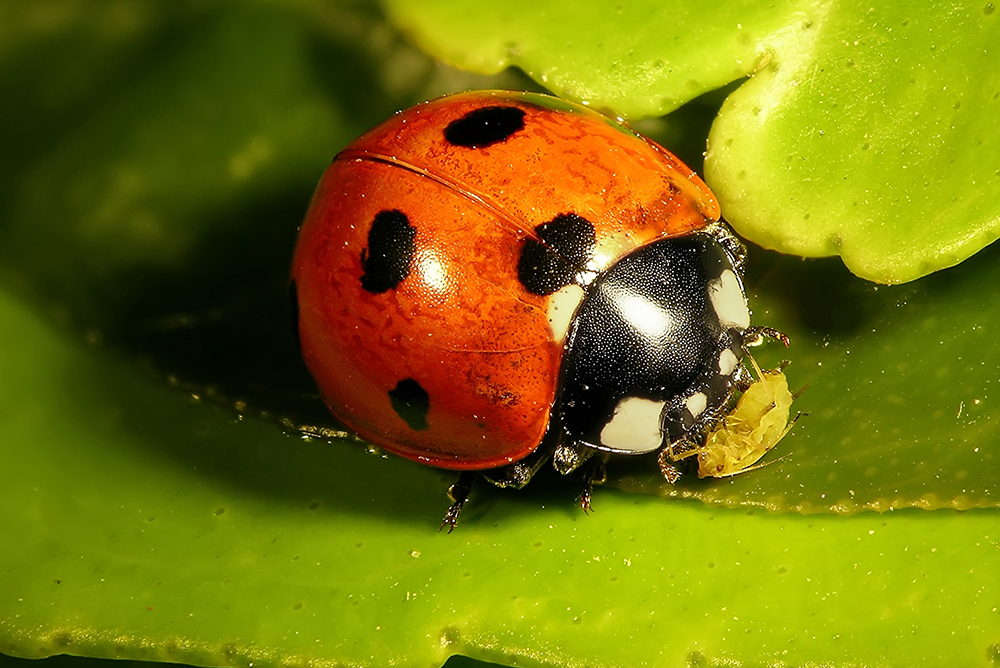
A ladybug on a leaf, a poison dart frog on a log, an eastern coral snake in grass, and a screech owl in a hollow tree trunk.

 © Darkdiamond67/Shutterstock, © Matthieu Berroneau—Moment Open, Mark Kostich—E+/Getty Images, © Mircea Costina/stock.adobe.com; Photo composite Encyclopædia Britannica, Inc.

Can you guess why each of these animals looks the way it does?


Have you ever wondered why leopards have spots or why poisonous snakes are brightly colored? Some animals are designed to blend in with their surroundings. Others are brightly colored to warn other species that they’re poisonous.


You can read more about animals and their colors at Britannica!

Word of the Day Icon

Word of the Day

camouflage

Part of speech:

noun

Definition:

: something (such as color or shape) that protects an animal from attack by making the animal difficult to see in the area around it

Definitions provided by
Merriam-Webster Logo
Game Icon

Play

Criss Cross

The animals in this puzzle have lots of legs! Can you figure out where they all go in this puzzle? 

O
O
O
O
O

In Case You Missed It

Mycelium grows fast, making it a great building material.
June 9, 2026
Farmers get annoyed when elephants eat their crops. But it’s possible the elephants understand that certain plants are great medicine.
June 4, 2026
Krista Richard fixes up old bikes and gives them to children.
June 2, 2026
Chinese workers helped build a railroad that stretched across the United States and changed the country.
May 28, 2026

Eye in the Sky

A large stationary Ferris wheel sits on top of a three story building in front of which people walk on a path.

Eye in the Sky

A huge Ferris wheel called the Twin Eye is being planned for the city of Seoul, South Korea.
A large stationary Ferris wheel sits on top of a three story building in front of which people walk on a path.
Seoul Observation Wheel, 2023, ©The Reits-Kempinsky Hotel & Resorts

This image was created to show what the Twin Eye will look like.

What’s the best way to get a bird’s eye view of a city? You could ride a giant Ferris wheel! A new Ferris wheel called the Twin Eye is being planned for Seoul, South Korea, and it won’t just be massive—it will also have an unusual design.

The Twin Eye is set to be 591 feet (180 meters) high, about as tall as a 45-story building. It will have 64 enclosed capsules, each able to hold 20 to 25 people, which means it will be able to carry more than 1,400 passengers at once! Because of the wheel’s size, passengers will be treated to a panoramic view of Seoul once they reach the top. There will be fun at the bottom, too. The wheel will sit on top of a building where people can watch performances and buy food and drinks.

Many people are familiar with Ferris wheels. They’re commonly found at theme parks and carnivals. Most Ferris wheels have spokes, which are bars that connect the outer part of the wheel to the center of the wheel. The entire wheel rotates, moving each car to the top and then back down to the bottom. The spokes help provide support to the outer part of the wheel.

Aerial view showing the location of a large Ferris wheel within a city.

Seoul Observation Wheel, 2023, ©The Reits-Kempinsky Hotel & Resorts

The Twin Eye will not have spokes, which suggests that riding it will be an unusual experience. Many times, with spokeless Ferris wheels, the wheel doesn’t move. Instead, the cars, or capsules, move around the edge of the wheel. The Twin Eye will look like a big, open circle in the sky.

The Twin Eye is set to be completed by the end of 2028.

Fun Fact Icon

Fun Fact

© Ian Whitworth/Dreamstime.com

In 2013, Clinton Shepherd rode a Ferris wheel in Chicago, Illinois, for 48 hours, eight minutes, and 25 seconds. Except for one five-minute break each hour, Shepherd was on the wheel for more than two days!

How Big Do Ferris Wheels Get?

Size comparison of large city Ferris wheels and a typical carnival Ferris wheel shown in measurements and diagrams.

Encyclopædia Britannica, Inc.

Ferris wheels come in all sizes. Around the world, people are building Ferris wheels that are much larger than the usual carnival Ferris wheel. 

The image above shows the world’s biggest Ferris wheels and how they compare to a carnival Ferris wheel (shown in the dotted red box).

Seoul, South Korea

© Adrian Catalin Lazar, Nattanai Chimjanon/Dreamstime.com, © Jupiterimages—PHOTOS.com/Getty Images, © nyker/stock.adobe.com; Photo composite Encyclopædia Britannica, Inc.

Seoul is the capital of South Korea. It was founded in 1394! You can read more about Seoul at Britannica.

Word of the Day Icon

Word of the Day

panoramic

Part of speech:
adjective
Definition:
: (of a view) full and wide
Definitions provided by
Merriam-Webster Logo
Game Icon

Play

Word Search
Can you find all the rides and amusements?
O
O
O
O
O

In Case You Missed It

Mycelium grows fast, making it a great building material.
June 9, 2026
Farmers get annoyed when elephants eat their crops. But it’s possible the elephants understand that certain plants are great medicine.
June 4, 2026
Krista Richard fixes up old bikes and gives them to children.
June 2, 2026
Chinese workers helped build a railroad that stretched across the United States and changed the country.
May 28, 2026

Lend Me a Pencil!

A student sits at a desk and writes in a notebook as her brain sits on top of her head and lifts weights.

Lend Me a Pencil!

Scientists say writing words by hand uses parts of the brain that aren’t active when we type those same words.

A student sits at a desk and writes in a notebook as her brain sits on top of her head and lifts weights.

© Good Studio/stock.adobe.com, © Xsviatx/Dreamstime.com; Animation Encyclopædia Britannica, Inc.

Writing things by hand may be good for our minds. A new study shows that parts of the brain are more active when we are handwriting words than when we’re typing them.

In the study, scientists at a university in Norway recorded the brain activity of 36 students while the students typed a word or handwrote it in cursive with a digital pen. The scientists wanted to see if either of these activities would cause two parts of the brain to be active at the same time. That’s a sign that different parts of the brain are communicating with one another.

The scientists found that when the students wrote words by hand, many parts of their brains were active. When the students typed words, fewer parts of the brain were active. This is partly because writing words with a pen or pencil requires more motor skills, which are skills having to do with moving the body. Typing doesn’t require as much movement. But handwriting also seems to cause more activity in parts of the brain related to learning and memory.

Audrey van der Meer is one of the scientists who was involved in the study. She says people may learn and remember information better when they write it down by hand. But that doesn’t mean everyone should stop using computers and tablets. Typing is often easier and faster than writing. Scientists say it’s possible that writing things down is better for some tasks and typing is better for others.

NEWS EXTRA!

Super Bowl Champs!

Two football players hug in celebration on the field as other players in the same uniform look on.

Jeff Speer—Icon Sportswire/Getty Images

Kansas City Chiefs wide receiver Mecole Hardman celebrates with Chiefs quarterback Patrick Mahomes (number 15). Hardman caught the game-winning touchdown pass.

For the second year in a row, the Kansas City Chiefs are Super Bowl champions. The Chiefs scored a 25-22 victory over the San Francisco 49ers. They’re the first team to win two Super Bowl titles back-to-back since the New England Patriots.

The Chiefs are only the seventh team in NFL history to win four Super Bowls.

Face Thinking Icon

Did You Know?

Library of Congress, Washington, D.C. (LC-USZ62-110307), The Metropolitan Museum of Art, New York (1998.538.1); Photo illustration Encyclopædia Britannica, Inc.

Printing type (words) was invented in about 1045 CE in Asia and 1440 CE in Europe. Before that, all books had to be written by hand. This was the job of a specially trained writer called a scribe. Scribes didn’t come up with the words—they only wrote them down.

Mirror Writing

Leonardo da Vinci’s illustration of his flying machine with parts labeled in mirror writing.

Science & Society Picture Library/Getty Images

Fifteenth-century artist and inventor Leonardo da Vinci often wrote backward, as shown above. Historians call this “mirror writing” because mirrors reflect writing (and everything else) backward.

No one is sure why Leonardo used mirror writing. Some people think he was trying to hide his ideas so they wouldn’t be stolen. Others believe he was trying not to smudge his writing. Leonardo was left-handed. If he wrote from left to right, the way most of us do, his left hand would have smeared the wet ink.

Writing in Pictures

© Basphoto/Dreamstime.com

There are many ways to write. You may know more than one! This sentence is written in the ABC alphabet, also called the Latin alphabet. Japanese, Korean, Arabic, and other languages use other alphabets.

Did you know that the ancient Egyptians used a writing system made up of pictures called hieroglyphics? You can read about hieroglyphics and see some examples at Britannica.

Word of the Day Icon

Word of the Day

transcribe

Part of speech:

verb

Definition:

 : to make a written copy of (something)

Definitions provided by
Merriam-Webster Logo
Game Icon

Play

Crossword

O
O
O
O
O

In Case You Missed It

Mycelium grows fast, making it a great building material.
June 9, 2026
Farmers get annoyed when elephants eat their crops. But it’s possible the elephants understand that certain plants are great medicine.
June 4, 2026
Krista Richard fixes up old bikes and gives them to children.
June 2, 2026
Chinese workers helped build a railroad that stretched across the United States and changed the country.
May 28, 2026

Solving a Primate Puzzle

Side view of a large primate walking on all fours with a white background.

Solving a Primate Puzzle

Scientists finally think they know why a giant primate went extinct over 200,000 years ago.
Side view of a large primate walking on all fours with a white background.
Concavenator (CC BY-SA 4.0)
Why did this giant ape go extinct?

A primate nearly twice the size of a gorilla once lived in the forests of southern Asia. But a little over 200,000 years ago, it went extinct. A group of researchers say they think they know why.

Scientists first identified the primate, called Gigantopithecus blacki or G. blacki, about 100 years ago based on the existence of huge teeth that didn’t match the teeth of existing primates. But they didn’t know why G. blacki no longer existed. What caused it to die out?

To answer that question, researchers collected some fossilized teeth and used a technique called luminescence dating to determine their age. The oldest teeth were more than two million years old, while the most recent were about 250,000 years old. Scientists estimated that G. blacki went extinct between 215,000 and 295,000 years ago.

Next, it was time to look at what happened toward the end of the primate’s existence. Scientists know that the climate changed around 600,000 or 700,000 years ago. The lush forests where G. blacki lived began to thin out. The fruit trees where it found most of its food were not as plentiful. Unlike other apes, G. blacki was too large to climb the trees and get the fruit that grew higher up. So, what did it eat? Scientists looked at the most recent G. blacki teeth and found scratches on them, suggesting that the huge primates started to eat less nutritious bark and twigs. Researchers say this is why G. blacki became extinct. It just couldn’t survive the changing environment.

Face Thinking Icon

Fun Fact!

© Josh/stock.adobe.com

What does Gigantopithecus blacki have in common with orangutans like the one in this video?

Despite its size, G. blacki is more closely related to orangutans than to larger apes like gorillas!

How Big Was This Beast?

Lineup of a human, an ostrich, Gigantopithecus, a white rhino, a giraffe, an African elephant and a gorilla with their heights and weights.
© Sabri Deniz Kizil/Dreamstime.com; Infographic Encyclopædia Britannica, Inc.

How large was Gigantopithecus blacki compared to some modern land animals?

What Makes an Ape an Ape?

A baby gorilla sleeps in the arms of an adult gorilla.
© Dalriada50—iStock/Getty Images
That’s one adorable ape! What’s the difference between an ape and a monkey? Learn this and more at Britannica!
Word of the Day Icon

Word of the Day

adaptation

Part of speech:
noun
Definition:
: a change in a plant or an animal that makes it better able to live in a particular place or situation
Definitions provided by
Merriam-Webster Logo
Game Icon

Play

Word Search

Primates are hidden all over this puzzle. Can you find them?

O
O
O
O
O

In Case You Missed It

Mycelium grows fast, making it a great building material.
June 9, 2026
Farmers get annoyed when elephants eat their crops. But it’s possible the elephants understand that certain plants are great medicine.
June 4, 2026
Krista Richard fixes up old bikes and gives them to children.
June 2, 2026
Chinese workers helped build a railroad that stretched across the United States and changed the country.
May 28, 2026

TEST

Japan’s Disappearing Snow Monsters

People are racing to save a beloved winter wonder on Japan’s Mount Zao.

Snow has covered evergreen trees on a hillside, making them look like snow creatures.

© weniliou/stock.adobe.com

These snow-covered trees on Japan’s Mount Zao are known as juhyo.

Each winter, giant snow monsters appear across the landscape of Japan’s Mount Zao. Though they may look like towering ghosts or abominable snowmen, these “monsters” are just trees encased in snow and ice. People travel from all over the world to see this rare natural wonder—but new research shows that it’s at risk of disappearing. 

The monsters, called juhyo in Japanese, occur when cold and windy weather brings a supercooled, icy rain to the mountain. The icy rain freezes immediately when it meets the fir trees, encasing them in layers of ice and snow. The phenomenon turns the whole mountain into an otherworldly landscape. 

However, a team of Japanese researchers confirmed that the snow monsters are not growing as large as they did nearly 100 years ago.

“In the 1930s, we saw juhyo five to six metres [16–20 feet] across,” said Fumitaka Yanagisawa to the BBC. Yanagisawa is a professor at Japan’s Yamagata University who studies juhyo. “Since 2019, many are half a metre [1.6 feet] or less. Some are barely columns.”

A man stands facing away from the camera and looking at snow-covered trees that resemble snow creatures.

© weniliou/stock.adobe.com

A hiker gets a look at Japan’s snow monsters.

Yanagisawa pointed to two environmental factors affecting the snow monsters: harmful insects and a warming climate. Insect outbreaks have hurt the fir trees, causing them to lose needles or damaging the bark, so many trees have died. This means there are fewer branches for the winter rain to freeze onto and create the iconic juhyo shape.

A warming climate also means the juhyo are melting faster and the special conditions that make the supercooled rain are increasingly rare. Still, the local community is racing to save the snow monsters. A collaboration between the local government and high school students is focusing on planting young fir trees on the mountain to revive the mountain forests.

“They are called snow monsters because nothing else looks like them,” said Kanon Taniai, one of the students helping plant trees, to the BBC. “I want the world to see them, and to feel how special Japan’s nature is.”

Which of these sports would you include in the Winter Olympics
4 answers

A Case of Mistaken Identity

A pack of Nanotyrannus dinosaurs attack a juvenile T. rex.

© Anthony Hutchings/Friends of the NC Museum of Natural Sciences

In this illustration, a pack of Nanotyrannus dinosaurs attack a Tyrannosaurus rex that is not fully grown.

Paleontologists have uncovered a new dinosaur predator, while also revealing a case of mistaken identity for a skeleton within a famous fossil called the Dueling Dinosaurs. 

The fossil shows two dinosaurs—a leaf-eating Triceratops and a young predator—seemingly locked in a deadly battle. For decades, many experts thought the small, fierce predator in the fossil was a teen Tyrannosaurus rex. However, a recent study confirms that the fossil is a related, but entirely different, “dwarf” species of tyrannosaur called the Nanotyrannus.

Ultimately, key clues helped reveal the identity of the predator skeleton. Paleontologists studied the fossil’s arm length and bone growth rings to conclude the tyrannosaur was a fully grown adult dinosaur—not a young one.

A computer rendering of a fossil of a Triceratops and a Nanotyrannus in a position that suggests they were fighting.

© Julius Csotonyi/Friends of the NC Museum of Natural Sciences

This is a computer-made image of a fossil showing a Triceratops (left) and a Nanotyrannus fighting.

The new identification shows how these predators compare to each other. An adult Nanotyrannus would have reached about 18 feet (5.5 meters) in length and weighed about 1,500 pounds (680 kilograms). This is a fraction of the size of the colossal T. rex, which could grow longer than 42 feet (12.8 meters) and weigh 18,000 pounds (8,165 kilograms). In other words, if the T. rex were a city bus, the Nanotyrannus would be a small car. 

“This discovery paints a richer, more competitive picture of the last days of the dinosaurs,” said Lindsay Zanno, who is head of paleontology at the North Carolina Museum of Natural Sciences, where the fossil is housed. 

“With enormous size, a powerful bite force and stereoscopic vision, T. rex was a formidable predator, but it did not reign uncontested. Darting alongside was Nanotyrannus—a leaner, swifter, and more agile hunter.”

Which of these sports would you include in the Winter Olympics
4 answers