Solar Eclipse!
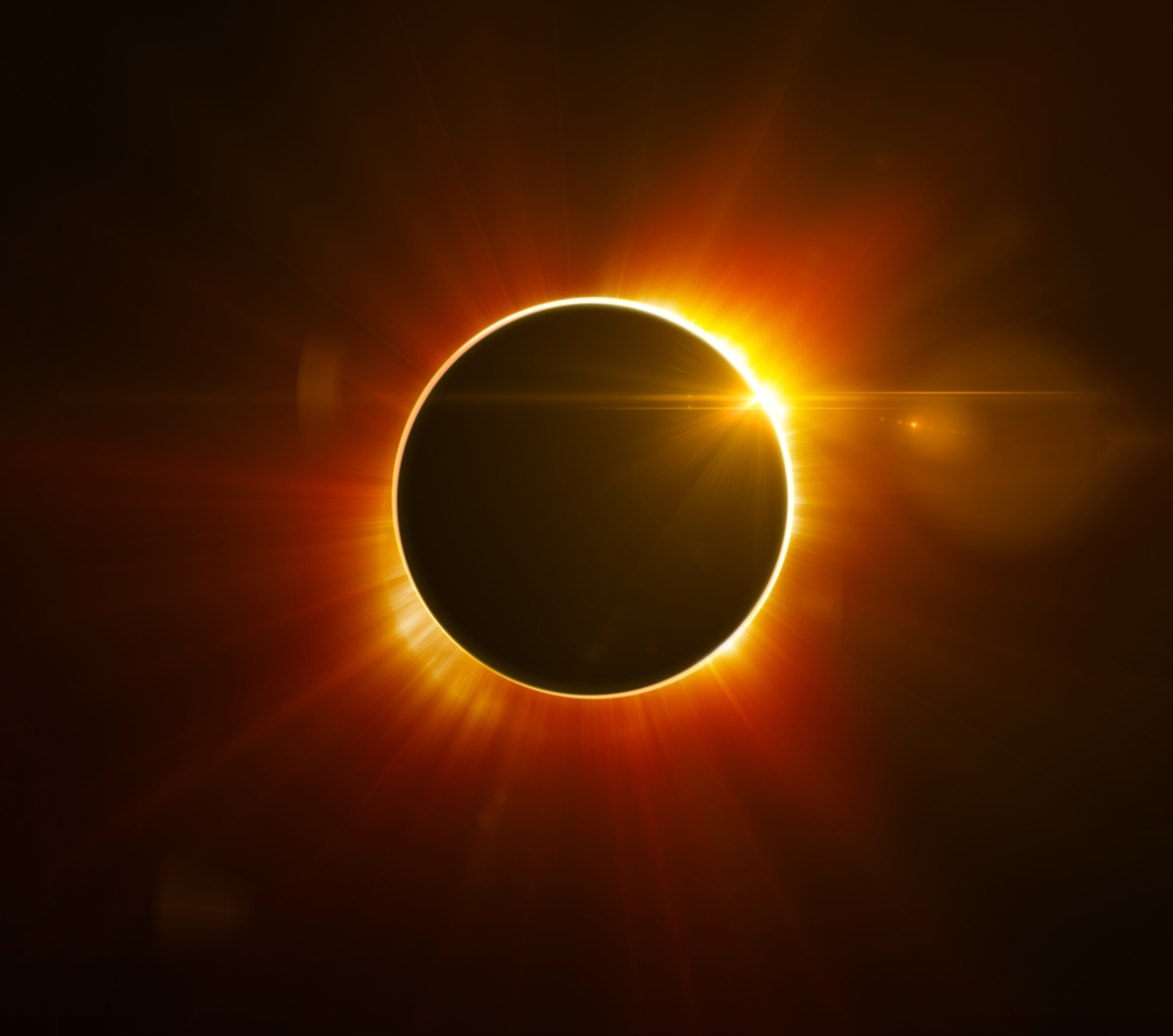
On April 8, a total solar eclipse will darken the daytime sky over part of North America. Areas of Mexico, the U.S., and Canada will be affected.
During a total solar eclipse, the Moon passes between Earth and the Sun, blocking the Sun completely. Along a narrow band on the surface of Earth, the sky goes dark for a short time. This band is called the path of totality. There, only the outer edge of the Sun (called the corona) can be seen.
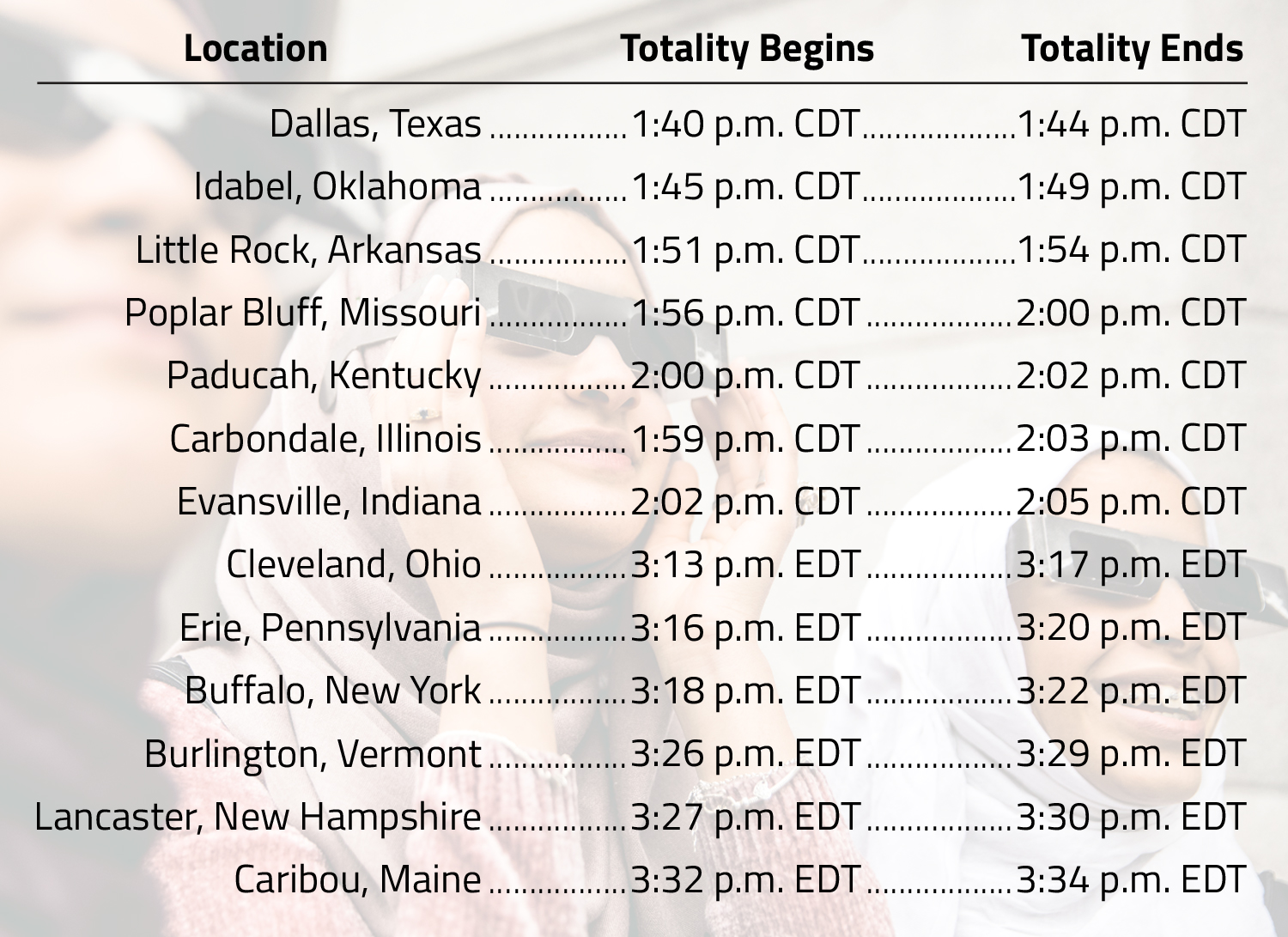
On April 8, totality, or complete darkness, will begin over the Pacific Ocean. Over time, the Moon’s shadow will move over Mexico and into the U.S. and then Canada. Totality in the United States begins in Texas just before 2:30 p.m. Eastern time. It ends in Maine at just after 3:30 p.m. Eastern time. Each location in the path of totality will be completely dark for only a few minutes or even seconds. But things won’t go back to normal right away. Before and after totality, the Moon will partially block the Sun. This is called a partial eclipse.
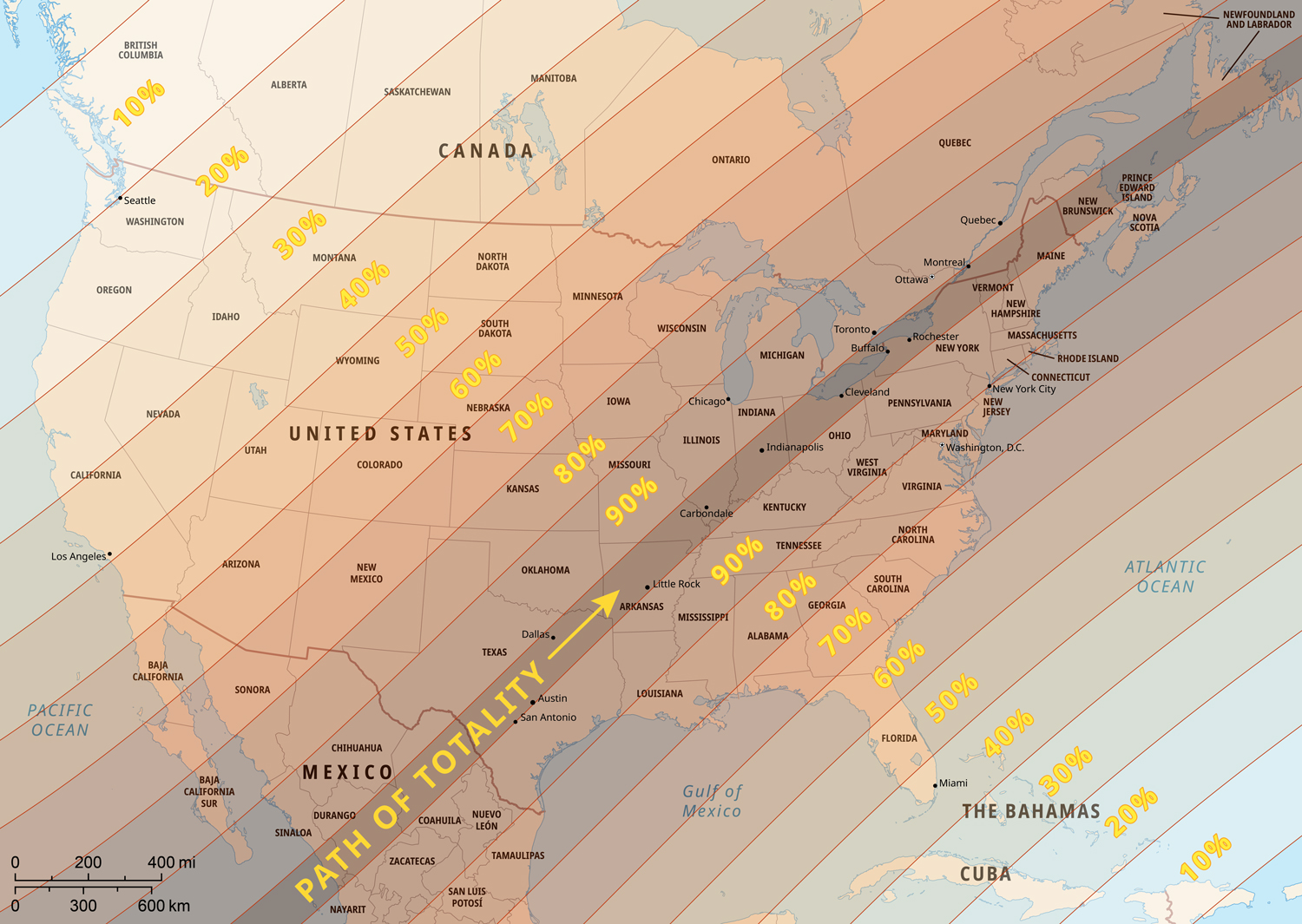
North Americans who live outside the path of totality will experience only a partial eclipse. But even a partial eclipse is worth experiencing. After all, solar eclipses are rare. Most of the United States won’t experience another total solar eclipse until 2044. (Part of Alaska will experience a total eclipse in 2033.)
Experts say it’s important to experience the eclipse safely. It’s dangerous to look directly at the Sun, even during an eclipse. If you watch the eclipse on April 8, be sure to use paper eclipse glasses or a handheld solar viewer. You can even make your own pinhole camera for safer viewing. The directions are farther down this page.

Did You Know?
Make a Pinhole Camera!
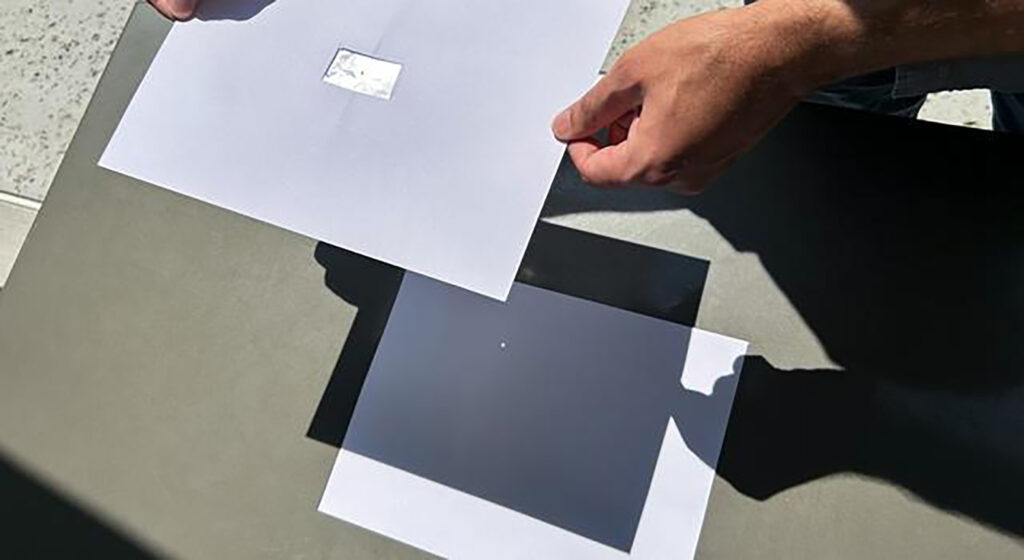
Never look at the Sun without proper protection. You can use a pinhole camera to experience a partial or total solar eclipse without looking at the sky. Here’s how to make one.
What You’ll Need
- Two pieces of white card stock or paper
- Aluminum foil
- Tape
- A pin, paper clip, or sharp pencil
Steps to Make the Camera
- Cut a 1– to 2-inch (2.5– to 5–centimeter) square or rectangular hole in the middle of one of the pieces of card stock.
- From your aluminum foil, cut a rectangle that’s larger than the hole in the card stock.
- Tape the foil over the hole in the card stock.
- Use the pin, paper clip, or pencil to poke a small hole in the foil.
- Just before the eclipse, put the second piece of card stock on the ground as you stand with the Sun behind you.
- Hold the first piece of card stock (the one with the foil) over the second piece. You’ll see a circle of light on the second piece of card stock. The farther apart the two pieces of card stock are, the larger the circle will be.
As the Moon passes in front of the Sun, the Moon’s shadow will pass over the circle of light.
What Causes an Eclipse?

Word of the Day
infrequent


Play
Word Search
Can you find all the words about eclipses?