A Pro at 13

A teen holds up a white jersey reading Kimbrough surrounded by adults and children in front of a backdrop reading Republic FC.

A Pro at 13

Thirteen-year-old Da’vian Kimbrough just became the youngest pro athlete in the history of American sports.
A teen holds up a white jersey reading Kimbrough surrounded by adults and children in front of a backdrop reading Republic FC.
Sacramento Republic FC
Da’vian Kimbrough (center) poses with his family and others after signing a contract with Sacramento Republic.

Da’vian Kimbrough is a pro soccer player—and he’s only 13. In August 2023, Kimbrough signed with Sacramento Republic, a professional soccer team in the U.S. He’s now the youngest professional athlete in the history of American team sports.

“Da’vian’s journey with Republic FC is just beginning,” said Sacramento Republic president and general manager Todd Dunivant. “He is a remarkable talent who has committed to his dream of becoming an elite player, from competing with players in older age groups, thriving at top competitions, to stepping on to the first team training grounds.”

Da’vian started playing in Republic’s youth academy in 2021, when he was 11 years old. He scored 27 goals in his first year. Thanks in part to Da’vian, his team wrapped up that season with the best record in its age group (30 wins and one loss). In two seasons of play for MLS Next, which is Major League Soccer’s youth division, Da’vian scored 61 goals.

Da’vian’s parents, who were both athletic when they were teens, said he’s been interested in sports since he was about 3, when he would watch footage of his dad playing football.

“We are so happy and honored,” Da’vian’s mom, Jessica Cervantes, told Fox 40 News. “All the hard work that he put in, and for Republic to put their trust in him, we greatly appreciate it.”

Da’vian’s dad, Dom Kimbrough, says the family will make sure their son still gets to be a kid. Cervantes says that while Da’vian is serious on the soccer field, he also knows how to let loose.

“He’s still like a regular teenager,” she told Fox 40 News. “When we get home, he’s a regular 13-year-old boy, having fun [and] laughing with us.” 

According to the team, Da’vian is eligible to begin playing with the major league team immediately, but he will also continue to sharpen his skills by training with the team’s academy.

“We are honored that the Kimbrough family and Da’vian have chosen Republic FC to support his professional pathway, and we look forward to taking the next steps together,” Dunivant said.

The video shows Kimbrough in action!

Sacramento Republic FC

Did You Know?

Have you ever wondered if you could get signed to a pro sports team? Many professional sports have age minimums that would keep even the most talented middle school—and high school—athletes out until they’re older. Here are a few examples.

NBA (basketball): Players must be at least 19 the year they’re drafted.

MLB (baseball): Players must be at least 17.

NFL (American football): Players can’t be drafted less than three years after they finish high school.

What about soccer? Soccer leagues all over the world set their own age requirements. In the U.S., players must be 18 before signing a professional contract. But younger players can sign with teams under special circumstances and with permission from a parent or guardian.

Check out the slideshow to read about some of the youngest pro athletes ever!

UPI/Bettmann Archive; Christian Liewig—Corbis Sport/Getty Images; US Youth Soccer National League; Bettmann/Getty Images; Tom Szczerbowski/Getty Images Sport

Soccer or Football?
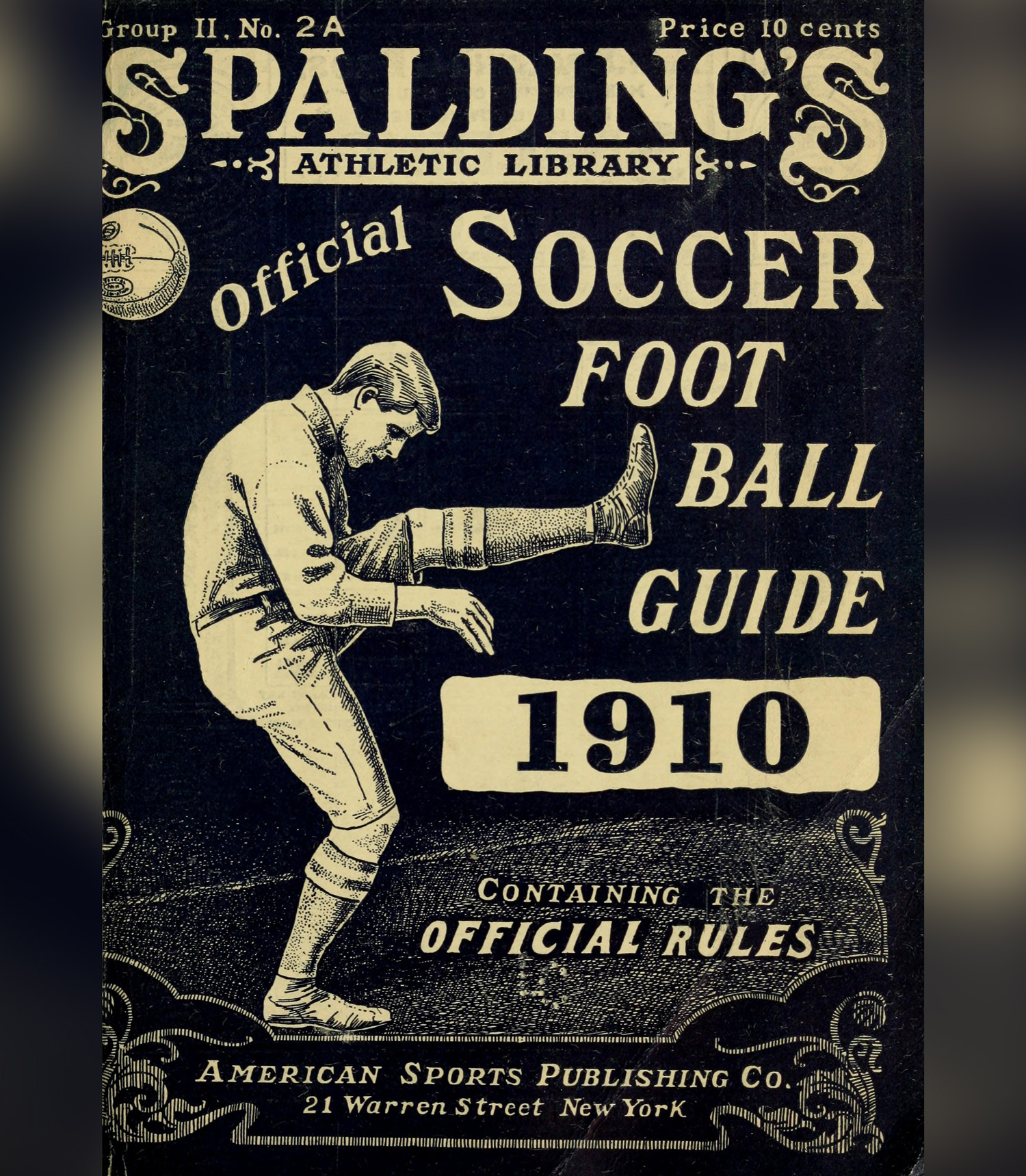
The cover of a soccer football guide from 1910 shows an athlete in uniform.
Library of Congress, Washington, D.C. (07018108)
Soccer? Football? In 1910, some people used both words.

What’s the name of the sport where players kick a round ball into a goal? In most countries, it’s called football. But in the U.S., it’s called soccer. Where did the term soccer come from, and why do Americans use it?

The word came not from the U.S. but from England. In the 1880s, students at the University of Oxford in England called this sport association football. They also played another football-type sport called rugby. Sometimes they used nicknames for these sports. Rugby was called rugger and association football was called assoccer. Over time, assoccer was shortened to soccer.

In England, people eventually settled on the names for these two sports. They were rugby and football. But Americans kept using the term soccer. That’s probably because Americans developed another sport that involves kicking a ball, which they call football!

Soccer’s GOAT?

A man on a soccer field with three other players behind him is about to kick a ball
dpa/Alamy

Who was the best soccer player of all time? It may have been Pelé, a Brazilian legend who electrified soccer fields in the 1950s, 1960s, and 1970s. 

You can read more about Pelé at Britannica!

WORD OF THE DAY

potential

PART OF SPEECH:
noun
Definition:
: an ability that someone has that can be developed to help that person become successful
Definitions provided by
Merriam-Webster Logo

Word Search

See if you can find all the words related to soccer (or football).

O
O
O
O
O
O

In Case You Missed It

The island of Corsica showed American colonists that a courageous revolution could defeat an empire.
May 7, 2026
Physicist Narinder Singh Kapany developed fiber optic cables, helping to make the Internet possible.
April 30, 2026
How can you tell whether photos and videos are real or made with AI? Here are a few tips.
April 24, 2026
A seemingly strange bank is saving one of Earth’s most valuable resources.
April 9, 2026

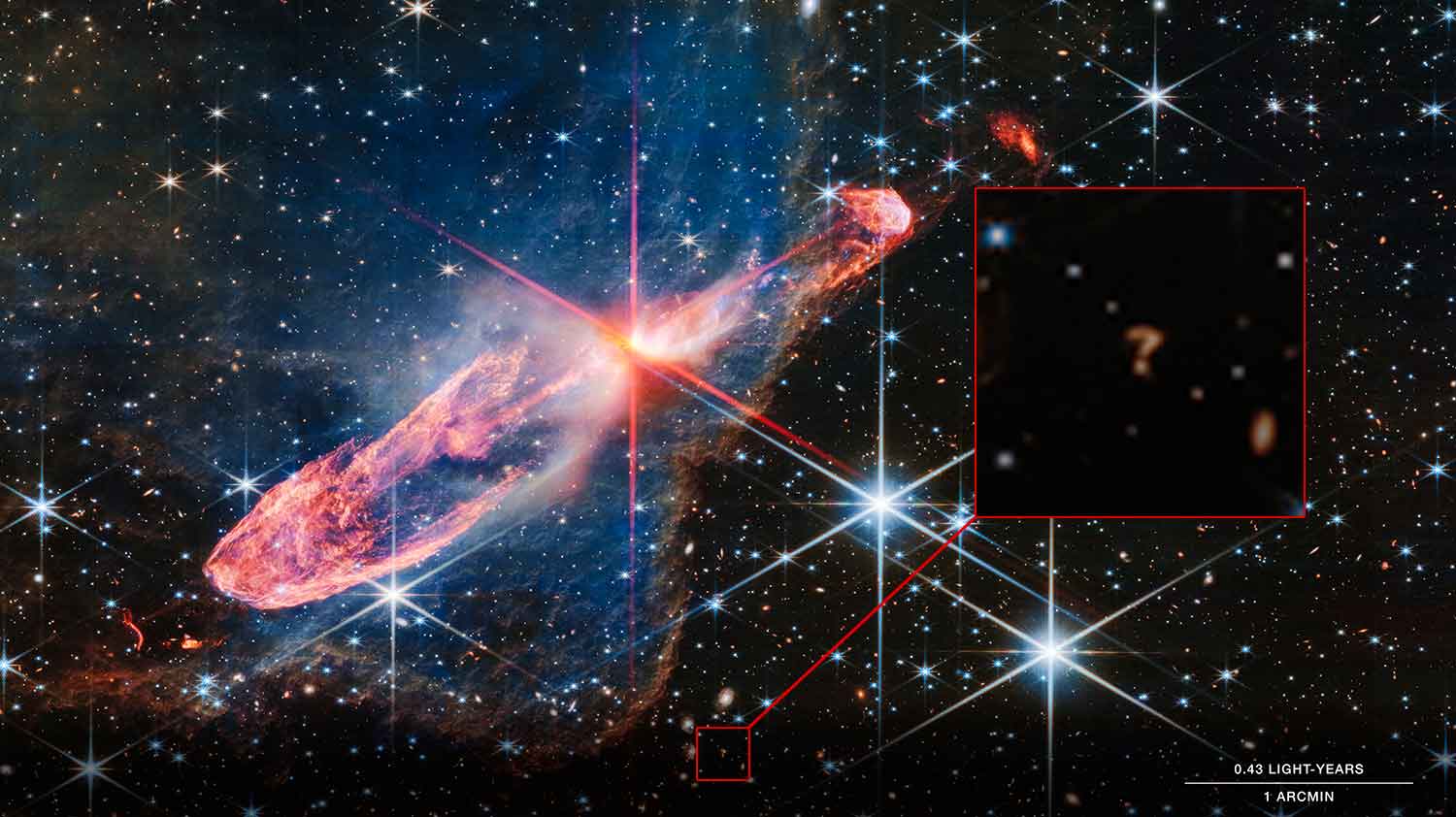
Is That a Question Mark?

A galaxy with an inset showing something in the shape of a question mark.

Is That a Question Mark?

A recent image from space seems to show a question mark. But it’s not a message from aliens.

A galaxy with an inset showing something in the shape of a question mark.

© NASA, ESA, CSA, J. DePasquale (STScI)

The James Webb Space Telescope captured this image, which includes what looks like a question mark.

The James Webb Space Telescope has given us some amazing images, and a few surprises. When some sharp-eyed people noticed what looked like a question mark in the background of a recent Webb image, it raised some, well, questions. Is there something in space that’s shaped like a question mark? Could this be a message from aliens? Scientists have answers.

What looks like a question mark is actually two or more galaxies that are in the process of merging, or coming together. Galaxies merge quite often, scientists say. In fact, between 10 and 25 percent of galaxies are merging at any given time. Our own Milky Way galaxy is the product of a merger.

“Many people think of galaxies like these little islands in space that don’t move, but nothing in the universe can be pinned down,” Matt Caplan, an assistant professor of physics at Illinois State University, told CBS News. “Stars move as they orbit the galaxy, and the galaxy—being made of gas and stars—moves whatever direction the gravity of nearby galaxies pulls it. The same is true of our Sun and Milky Way.”

Nora Luetzgendorf of the European Space Agency believes that the arc of the question mark might be a tidal tail, a shape that forms due to the gravitational interaction between two galaxies. The dot might be another, smaller galaxy.

While galaxies merge quite often, we don’t often get to see it happen—which makes this question mark special, even if it’s not a message from aliens.

Macarena Garcia Marin is a Webb project scientist with the Space Telescope Science Institute, which manages the telescope’s science operations. “I think we all enjoy finding familiar shapes in the sky; that creates a deep connection between our human-experience and language in this case (a question mark!) and the beauty of the Universe surrounding us,” Garcia Marin told National Public Radio. “To me it brings the question of how many other interesting objects are out there waiting to be explored with Webb!”

Fun Fact

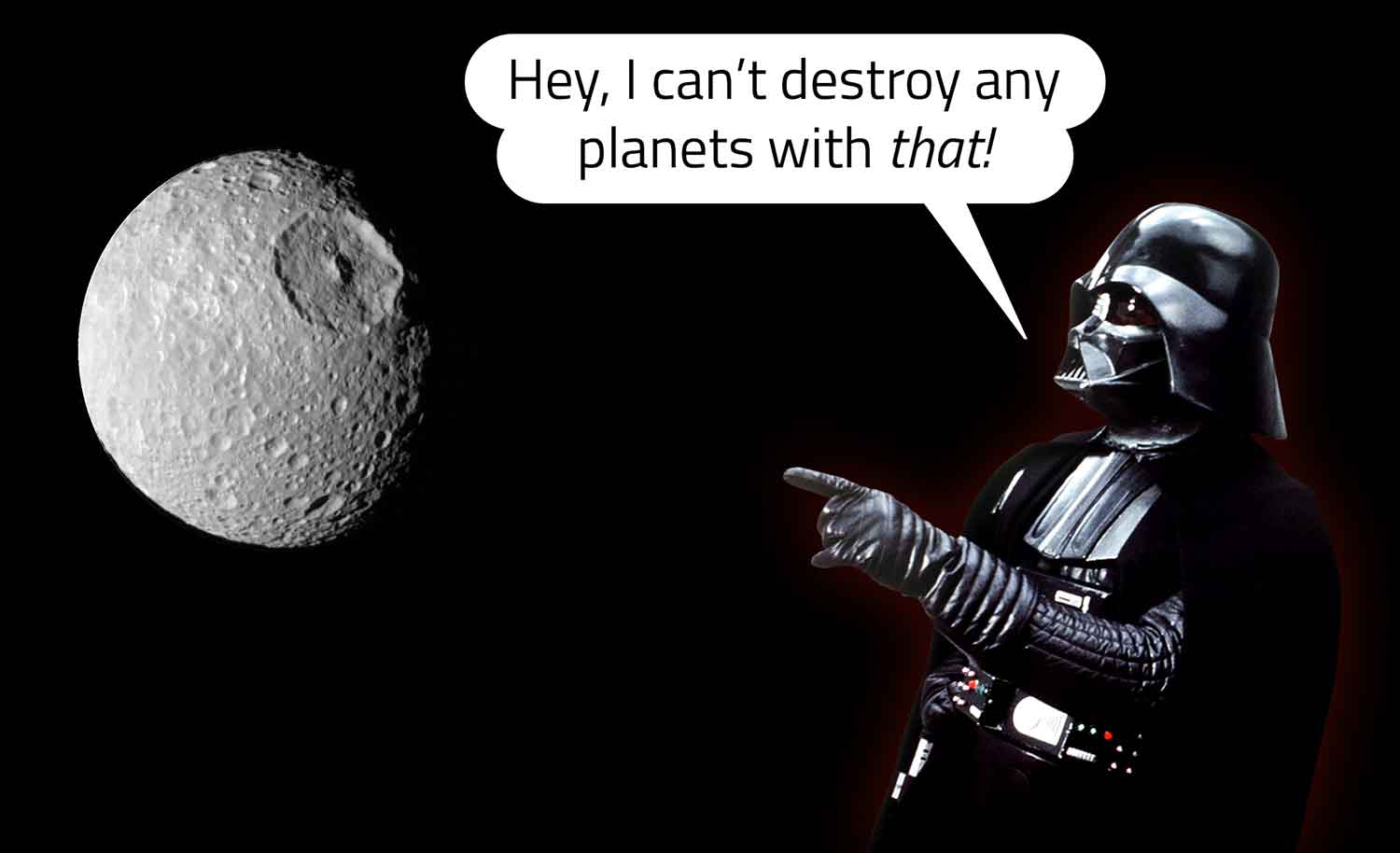
© Twentieth Century Fox, NASA/NPL/Space Science Institute; Photo illustration Encyclopædia Britannica, Inc.

Many space objects look a lot like objects that humans invented. Mimas, which is one of Saturn’s moons (shown in the photo), resembles the Death Star from the Star Wars movies!

Why Aren’t Asteroids Round?

An asteroid in space

ESA 2010 MPS for OSIRIS Team MPS/UPD/LAM/IAA/RSSD/INTA/UPM/DASP/IDA

Asteroids aren’t massive enough to be round.

Why are planets round, while asteroids aren’t? A space object’s shape has to do with its mass and the effect of gravity.

Think of the planets, which are all spherical. This is because the gravitational force of a planet’s mass pulls all its material toward the center, resulting in a sphere.

Smaller objects have less mass, so their gravity is not enough to smooth out their shape. Asteroids, for example, may look like potatoes or like pieces of gum that have been chewed. In other words, they take on weird, irregular shapes. Gravity doesn’t affect an asteroid’s shape, but other things can. For example, sometimes two asteroids collide and stick together. If you imagine two lumps of clay being smashed together, you’ll get a sense of why this might result in an odd shape!

One in a Billion?

NASA, ESA, CSA, and J. Lee (NOIRLab); image processing: A. Pagan (STScI)

Did you know there are billions of galaxies in the universe? How big are galaxies, and when were they formed? You can find the answers to these questions and more at Britannica!

WORD OF THE DAY

elliptical

PART OF SPEECH:

adjective

Definition:

: shaped like a flattened circle

Definitions provided by
Merriam-Webster Logo

Wordrow

O
O
O
O
O
O

In Case You Missed It

The island of Corsica showed American colonists that a courageous revolution could defeat an empire.
May 7, 2026
Physicist Narinder Singh Kapany developed fiber optic cables, helping to make the Internet possible.
April 30, 2026
How can you tell whether photos and videos are real or made with AI? Here are a few tips.
April 24, 2026
A seemingly strange bank is saving one of Earth’s most valuable resources.
April 9, 2026

Here to Help

Several people sort through food, water, and other emergency supplies outdoors under a shelter.

Here to Help

Volunteers and others are providing aid to people affected by a fire that destroyed part of Maui in August.

Several people sort through food, water, and other emergency supplies outdoors under a shelter.

Yuki Iwamura—AFP/Getty Images

Volunteers sort through donations given to help those affected by the fire in Maui.

Relief workers, volunteers, and celebrities rushed to help after a fire devastated part of the Hawaiian island of Maui. The blaze, which ignited on August 8, 2023, killed at least 100 people and destroyed thousands of buildings, including many homes.

The fire left many people homeless and in need of food, shelter, and basic supplies. Local charitable organizations are helping, many of them with assistance from national and international organizations like the American Red Cross. For example, the Maui Strong Fund collects donations and distributes the money to organizations that provide shelter, food, and financial help. A group called Chef Hui brings together chefs, farmers, and others in the food industry who are willing to supply food and prepare meals for people in need.

Help has also come from the mainland. Americans from many states have sent supplies or money to Maui. Workers with the American Red Cross and other organizations have flown from their home states to the island to help in any way they can.

“They’ve lost everything,” Andrea Webb, who works with the American Red Cross of New Jersey, told CBS News in New York, after landing in Hawaii. “They need some kind of help with anything even if it’s a hug, a kind word.”

Celebrities have brought attention to the disaster as well. Actor Matthew McConaughey announced he would pay for a plane to fly supplies to Maui. Famed surfer Archie Kalepa and some volunteers are distributing supplies from the front yard of Kalepa’s Maui home. And actor Auliʻi Cravalho, who is Native Hawaiian, created an Instagram post urging fans to make donations.

If you are interested in helping, make sure your donation will get to the people of Maui. Ask an adult to help you find a trusted charitable organization.

Did You Know?

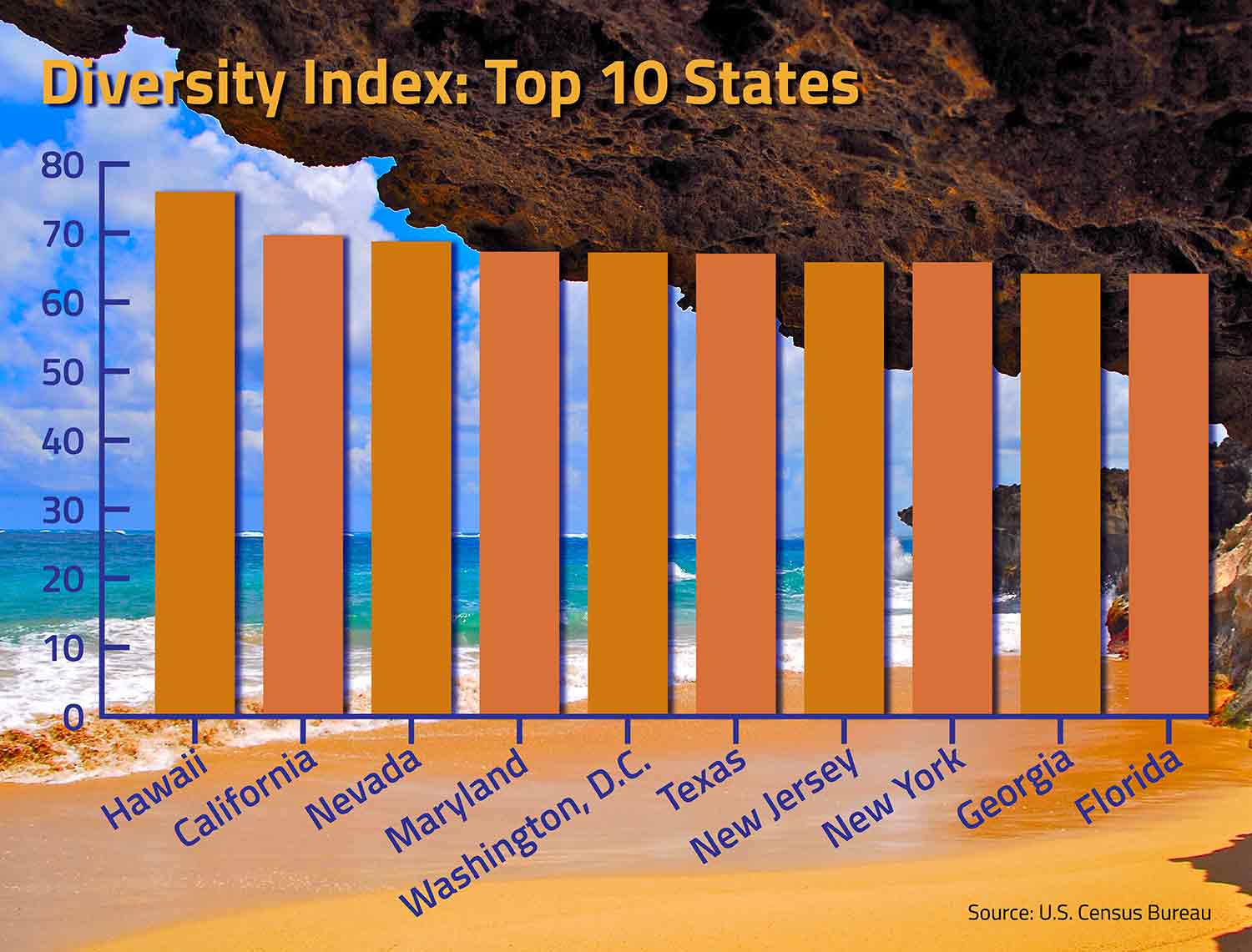
© Gdayton/Dreamstime.com; Infographic Encyclopædia Britannica, Inc.

Hawaii’s population is more diverse than that of any other U.S. state. This is based on the U.S. Census Bureau Diversity Index, which measures the probability that two people from a population will be from different racial or ethnic groups.

A Trip Through Time

A replica of an ancient canoe with orange sails carries several people on a body of water with green mountains in the background.

Courtesy of Polynesian Voyaging Society, © Na’alehu Anthony—Oiwi TV

In 1975, a group of people built the type of boat ancient Polynesians would have used to travel from the Marquesas Islands to Hawaii.

Did you know that Hawaii once had kings and queens? Take a journey through the long history of the 50th U.S. state…

The first European to set foot in Hawaii was Captain James Cook of England, in 1778. By the time Cook arrived, people had been living on the islands for about 1,500 years.

People first arrived in Hawaii in about 300 CE. They probably originated in the Marquesas Islands and traveled thousands of miles by canoe until they reached the Hawaiian Islands. For centuries, Hawaiians lived in small communities ruled by chieftains. The Hawaiian people developed a culture rich with oral storytelling, music, and a vast knowledge of local plants and animals. This is what Captain Cook would have observed when he first visited Hawaii in 1778.

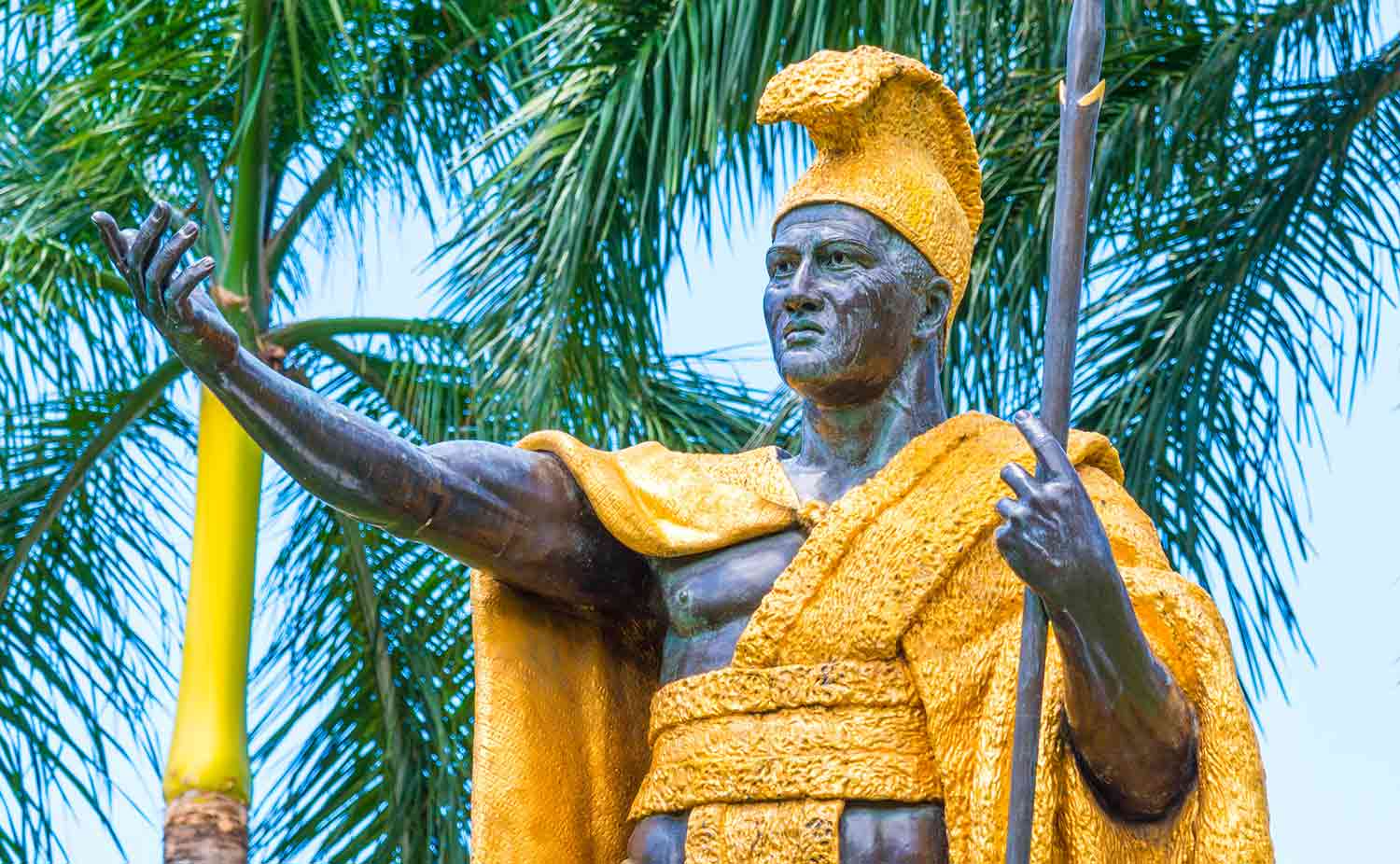
By 1810, the islands were ruled by one leader—King Kamehameha I—who had conquered all of Hawaii. Hawaii would be ruled by monarchs for another nearly 85 years.

© Gordon Fahey/stock.adobe.com

King Kamehameha I once ruled all of Hawaii. Today, there is a statue of Kamehameha in Honolulu, the state capital.

During the 19th century, Europeans and Americans visited Hawaii several times, and some came to stay. Over time, Americans increased their domination of Hawaii. They introduced their culture, beliefs, and more to the Hawaiian people—and forced them to recognize and accept a more American way of life. By the late 19th century, Americans were operating sugar plantations on Hawaii. These large farms made Americans wealthy, which made them want even more control over the islands.

In 1893, Americans overthrew the monarchy. Seven years later, the United States annexed (took control of) Hawaii. Hawaii would become the 50th U.S. state in 1959.

Volcanic Islands

© Earth Pixel LLC/stock.adobe.com

Did you know the Hawaiian Islands are the tops of volcanoes? There’s a lot more to learn about Hawaii!

WORD OF THE DAY

compassion

PART OF SPEECH:

noun

Definition:

: a feeling of wanting to help someone who is sick, hungry, in trouble, etc.

Definitions provided by
Merriam-Webster Logo

Word Search

See if you can find all the words about Hawaii.

O
O
O
O
O
O

In Case You Missed It

The island of Corsica showed American colonists that a courageous revolution could defeat an empire.
May 7, 2026
Physicist Narinder Singh Kapany developed fiber optic cables, helping to make the Internet possible.
April 30, 2026
How can you tell whether photos and videos are real or made with AI? Here are a few tips.
April 24, 2026
A seemingly strange bank is saving one of Earth’s most valuable resources.
April 9, 2026

Treasure Found in Kentucky!

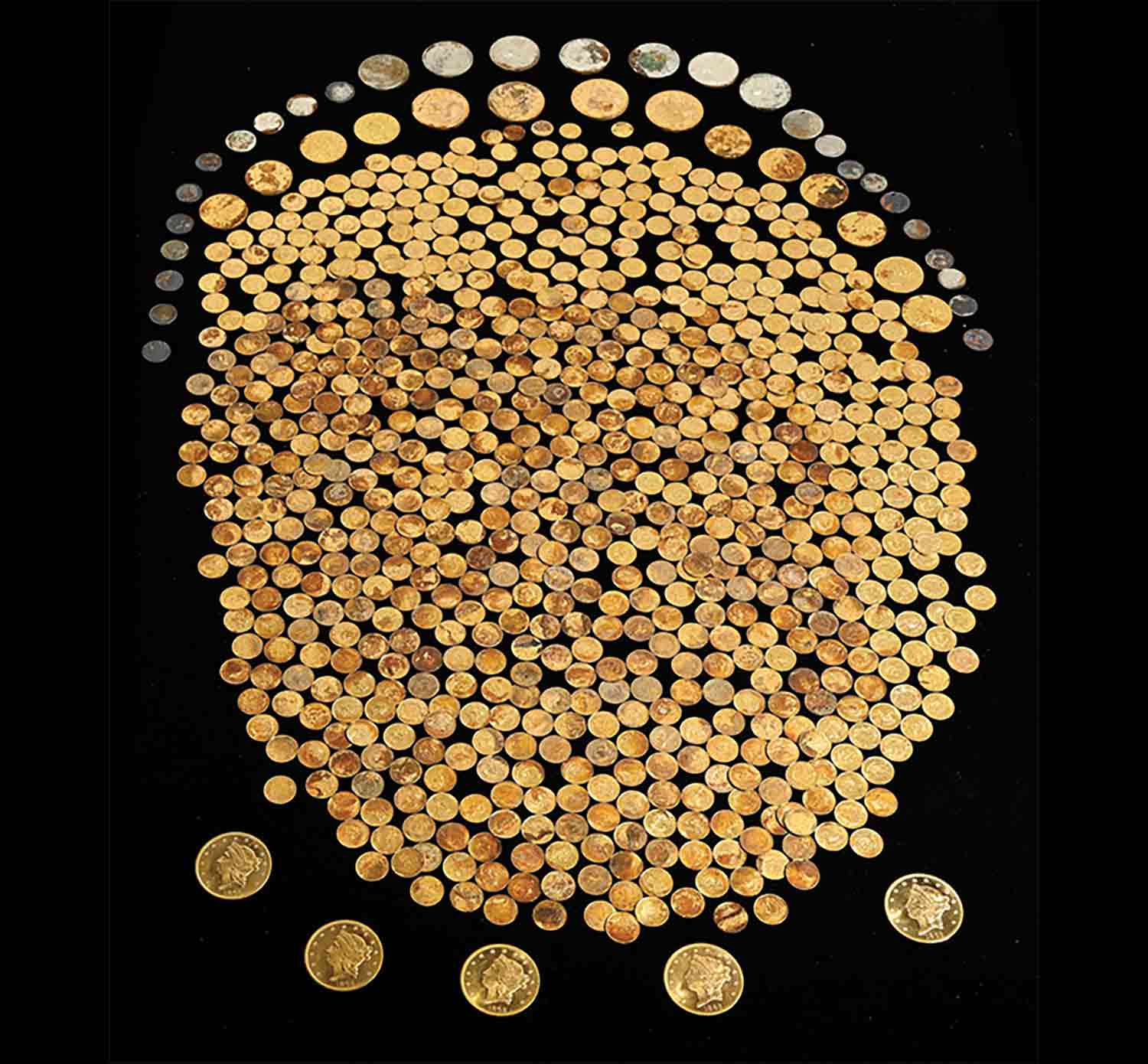
A large group of gold coins with larger gold and silver coins arranged around the pile.

Treasure Found in Kentucky!

A man found more than 700 gold coins in a cornfield. The coins were probably buried in the 1860s.

A large group of gold coins with larger gold and silver coins arranged around the pile.

Photo courtesy of Asset Marketing Services, LLC

The Great Kentucky Hoard, which was probably buried in the 1860s, was discovered in 2023.

A man found more than 700 gold coins dating back to the U.S. Civil War in a cornfield in Kentucky. Experts say the total value of the coins, which are more than 160 years old, is between one and two million dollars.

The coins were likely buried by someone who wanted to protect their money from an enemy raid. During the Civil War, which spanned from 1861 to 1865, the North fought against the South, which had broken away from the United States and formed the Confederate States of America (or the Confederacy). The root of the conflict was the South’s belief that slavery should remain legal. However, some states, including Kentucky, declared themselves neutral or remained loyal to the North even though they also permitted slavery.


The coins are U.S. money, not Confederate money. And the person who buried them probably sympathized with the North and feared a raid by Confederate troops. The person probably died before the end of the war or forgot exactly where they had hidden the coins.

The dates on the coins range from 1840 to 1863, so experts think the trove was buried in 1863. That has enabled them to identify the Confederate general who was about to invade Kentucky.

“It is entirely possible this [treasure] was buried in advance of Confederate John Hunt Morgan’s June to July 1863 raid,” Ryan McNutt, a conflict archaeologist at Georgia Southern University, told Live Science. Morgan raided Kentucky twice—once in 1862 and again in 1863. Both attempts failed to achieve their goals.

Coin experts and historians are calling the find the “Great Kentucky Hoard.” The coins are very rare, which is why they’re worth more than one million dollars.

“The importance of this discovery cannot be overstated, as the stunning number of over 700 gold dollars represents a virtual time capsule of civil war-era coinage,” rare coin dealer Jeff Garrett said in a statement.

Did You Know?

Carol M. Highsmith Archive/Library of Congress, Washington, D.C. (LC-DIG-highsm-11617)

Abraham Lincoln, the president of the United States during the U.S. Civil War, was killed in 1865 as he sat and watched a play at Ford’s Theatre in Washington, D.C. 

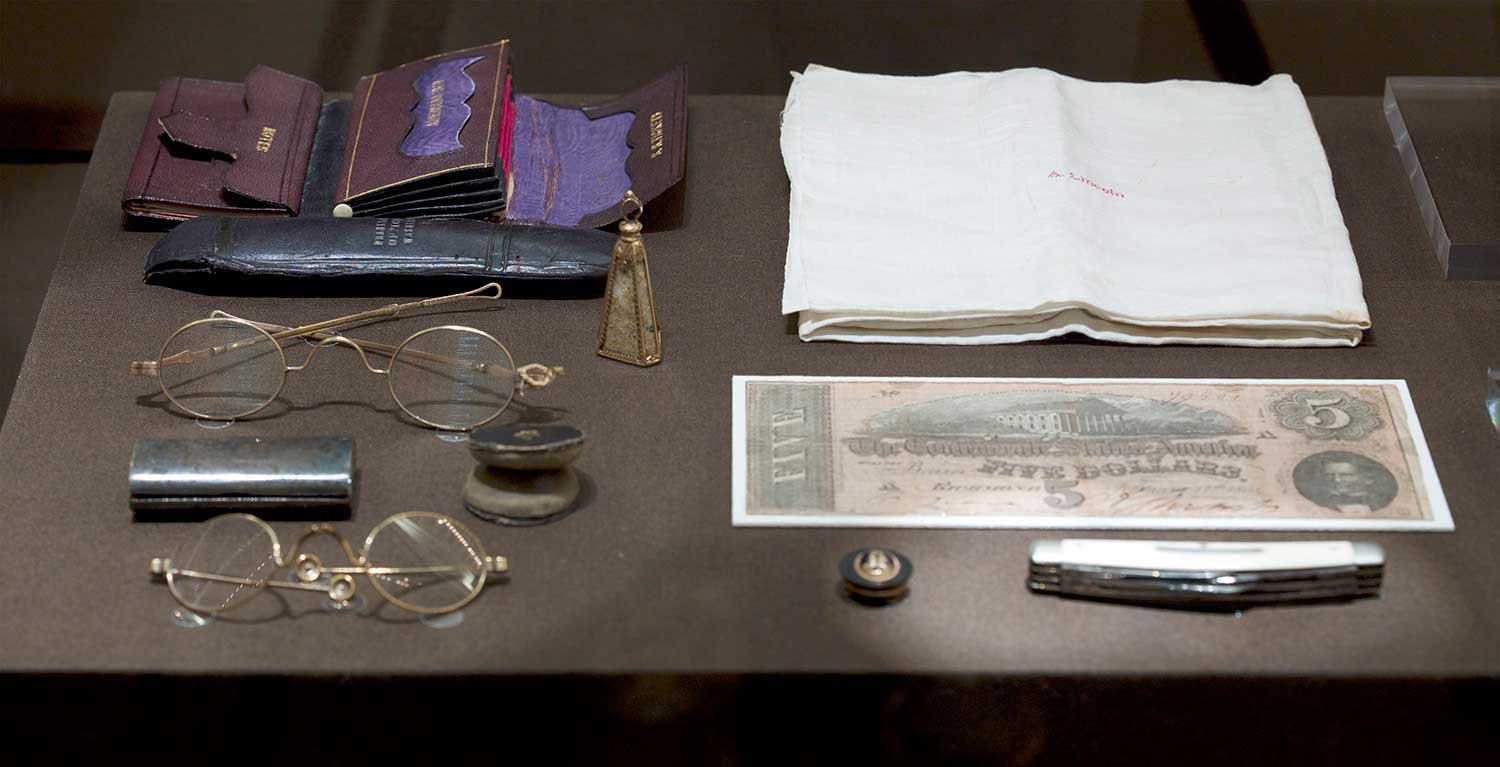
In his pockets, Lincoln was carrying two pairs of glasses, a lens polisher, a pocketknife, a watch fob (a chain that attaches to a pocket watch), a handkerchief with “A. Lincoln” stitched on it, and a wallet containing a five-dollar Confederate bill. He also had eight articles that he had cut out of a newspaper. Some of the articles were about him.

The photo shows the actual contents of Lincoln’s pockets on the night he was assassinated.

Tales of Treasure

A man in Kentucky found buried treasure. Does this mean there are more treasures to be found? Possibly! Here are just a few treasures that are rumored to be hidden.

  • According to legend, when the U.S. Civil War began, a Kentucky man named William Pettit buried about $80,000 (worth about $1.5 million today) in gold coins on his farm. He died before he could dig up the money, and it has never been found.

  • In 1641, a ship called the Merchant Royal sank near the coast of Britain after a voyage from Mexico, which was then a Spanish colony. The ship was carrying 100,000 pounds (45,000 kilograms) of gold and 400 bars of silver that the Spanish had taken from Mexico. In 2019, authorities found what they believe is the ship’s anchor. The ship—and its treasure—remain hidden.

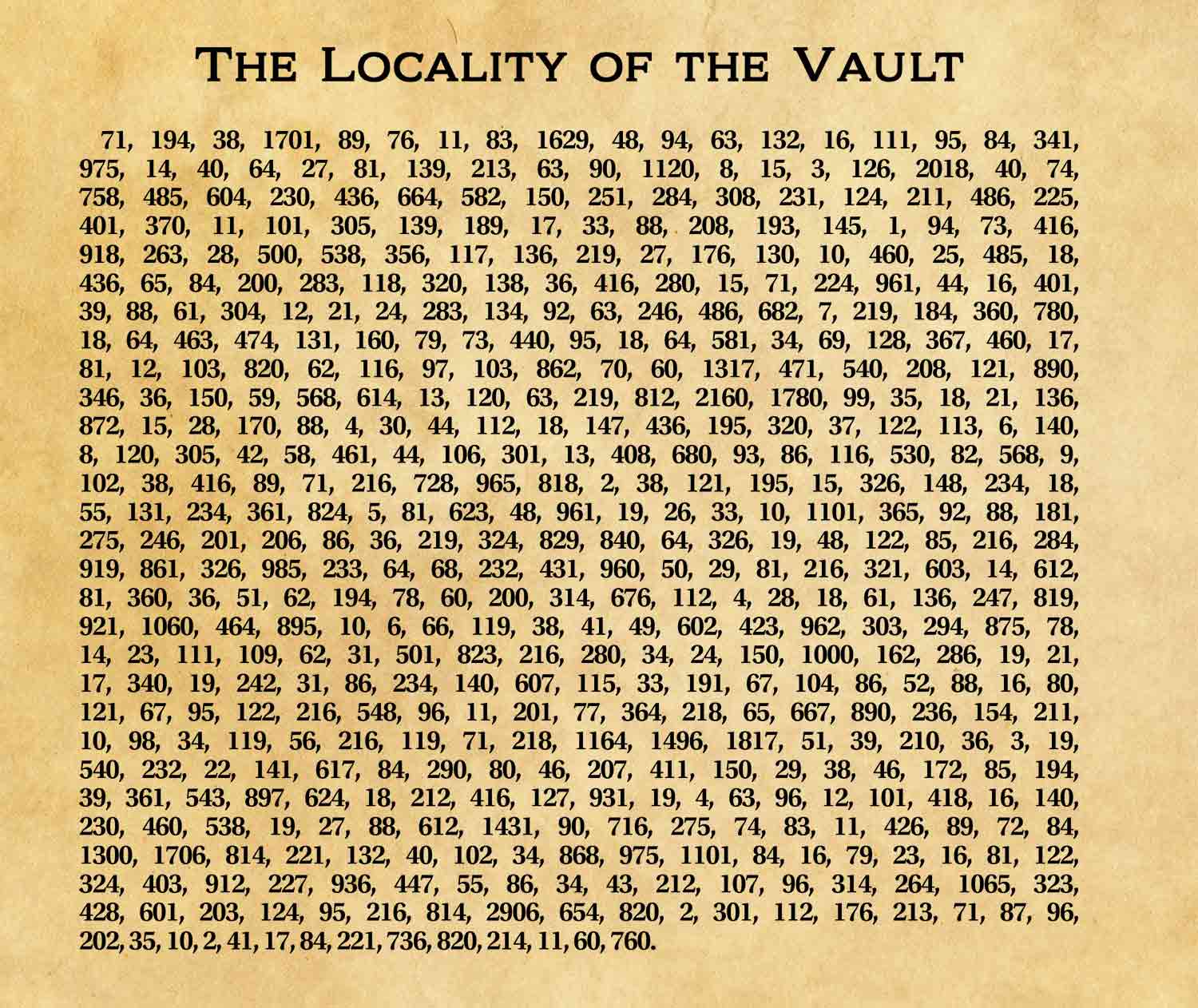
  • In the early 1800s, Thomas J. Beale found an abandoned mine containing gold, silver, and jewels in what’s now the U.S. state of Colorado. He and a group of other people hid the treasure and wrote three coded messages that revealed its location. He put the messages in an iron box and gave it to an innkeeper in Virginia, telling him to open the box if he did not return in 10 years. After more than two decades, the innkeeper opened the box but was unable to crack the code. To this day, only one of the messages has been deciphered, and the treasure hasn’t been found.
A long list of numbers separated by commas under the title The Locality of the Vault on a yellowed background.

Encyclopædia Britannica, Inc.

This is a recreation of one of Thomas J. Beale’s coded messages.

More to Discover

Michael Crabtree–PA Images/Getty Images

This gold was retrieved from the wreck of the SS Central America, a ship that sank in the 1850s.

Can’t get enough buried treasure? You can read more about treasure hunting at Britannica School!

WORD OF THE DAY

hoard

PART OF SPEECH:

noun

Definition:

: a large amount of something valuable that is kept hidden

Definitions provided by
Merriam-Webster Logo

Cross Cross

O
O
O
O
O
O

In Case You Missed It

The island of Corsica showed American colonists that a courageous revolution could defeat an empire.
May 7, 2026
Physicist Narinder Singh Kapany developed fiber optic cables, helping to make the Internet possible.
April 30, 2026
How can you tell whether photos and videos are real or made with AI? Here are a few tips.
April 24, 2026
A seemingly strange bank is saving one of Earth’s most valuable resources.
April 9, 2026

Viral Video Puts Sun Bear in Spotlight

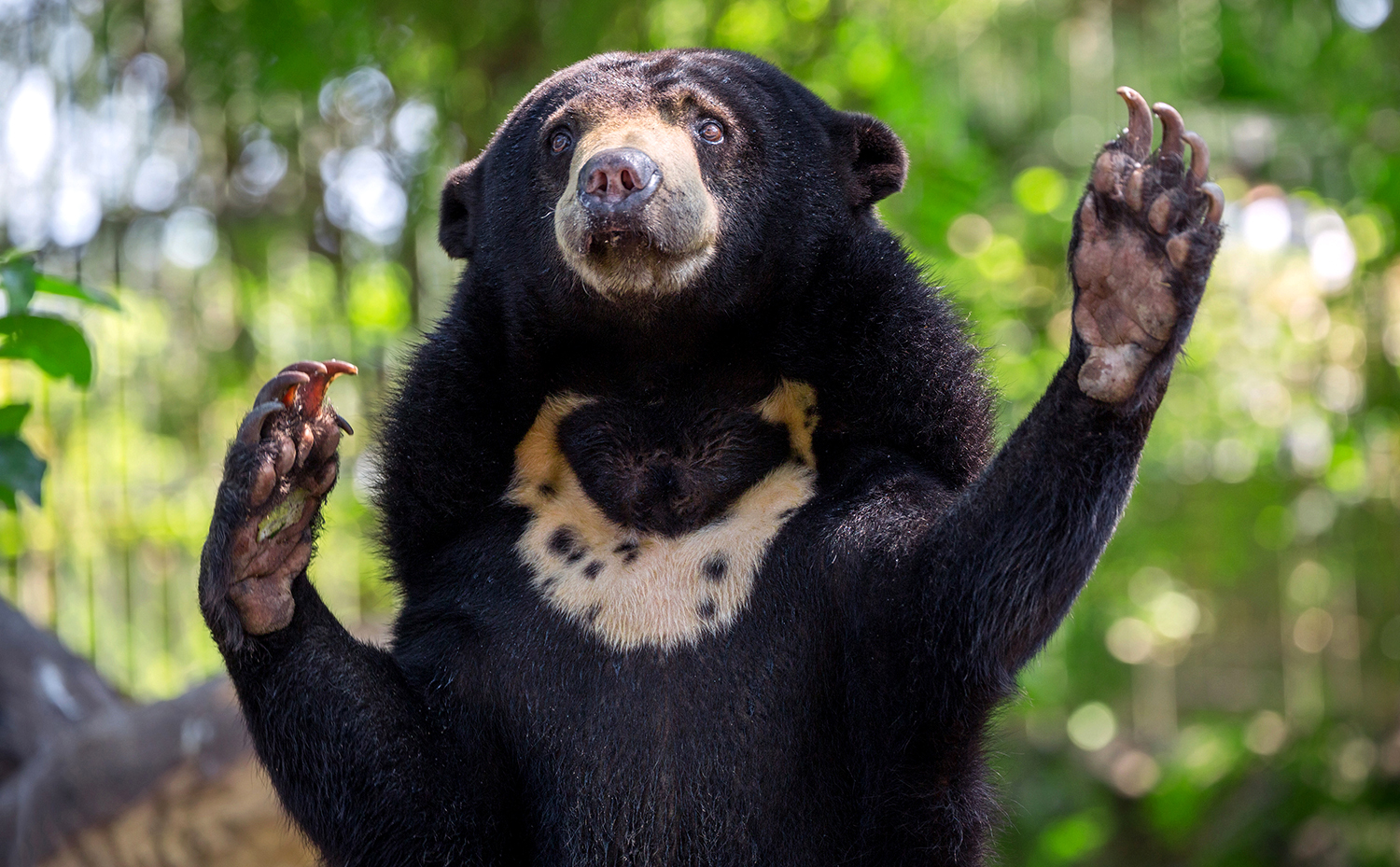
Top half of a sun bear standing on its hind legs and holding up its two front paws.

Viral Video Puts Sun Bear in Spotlight

When people started talking about a video of a sun bear, conservationists saw an opportunity to save the species.

Top half of a sun bear standing on its hind legs and holding up its two front paws.

© MrPreecha/stock.adobe.com

The sun bear gets its name from the “bib” of fur around its neck.

A sun bear named Angela turned into a major influencer after a video from a Chinese zoo went viral. Scientists are hoping that the popularity of the video will shed some light on sun bears, which are little known but endangered.

The video, which was recorded at Hangzhou Zoo in China, showed Angela standing on two legs and seeming to wave to a crowd from her enclosure. The bear looked so human that many people were convinced that it was a person in a costume. Eventually, biologists weighed in on the debate. The verdict? Angela is a real sun bear. In fact, it’s not unusual for sun bears to stand on their hind legs, making them seem humanlike because of their relatively small size.

Biologists say one reason for the misunderstanding is that most people know very little about sun bears, especially compared to their larger cousins, such as grizzly bears and polar bears. So, here are some facts.

  • Of the world’s eight bear species, the sun bear is the smallest, weighing 59 to 143 pounds (27 to 65 kilograms) and growing to 3.3 to 4 feet (1 to 1.2 meters) long.
  • The sun bear lives only in Southeast Asian forests.
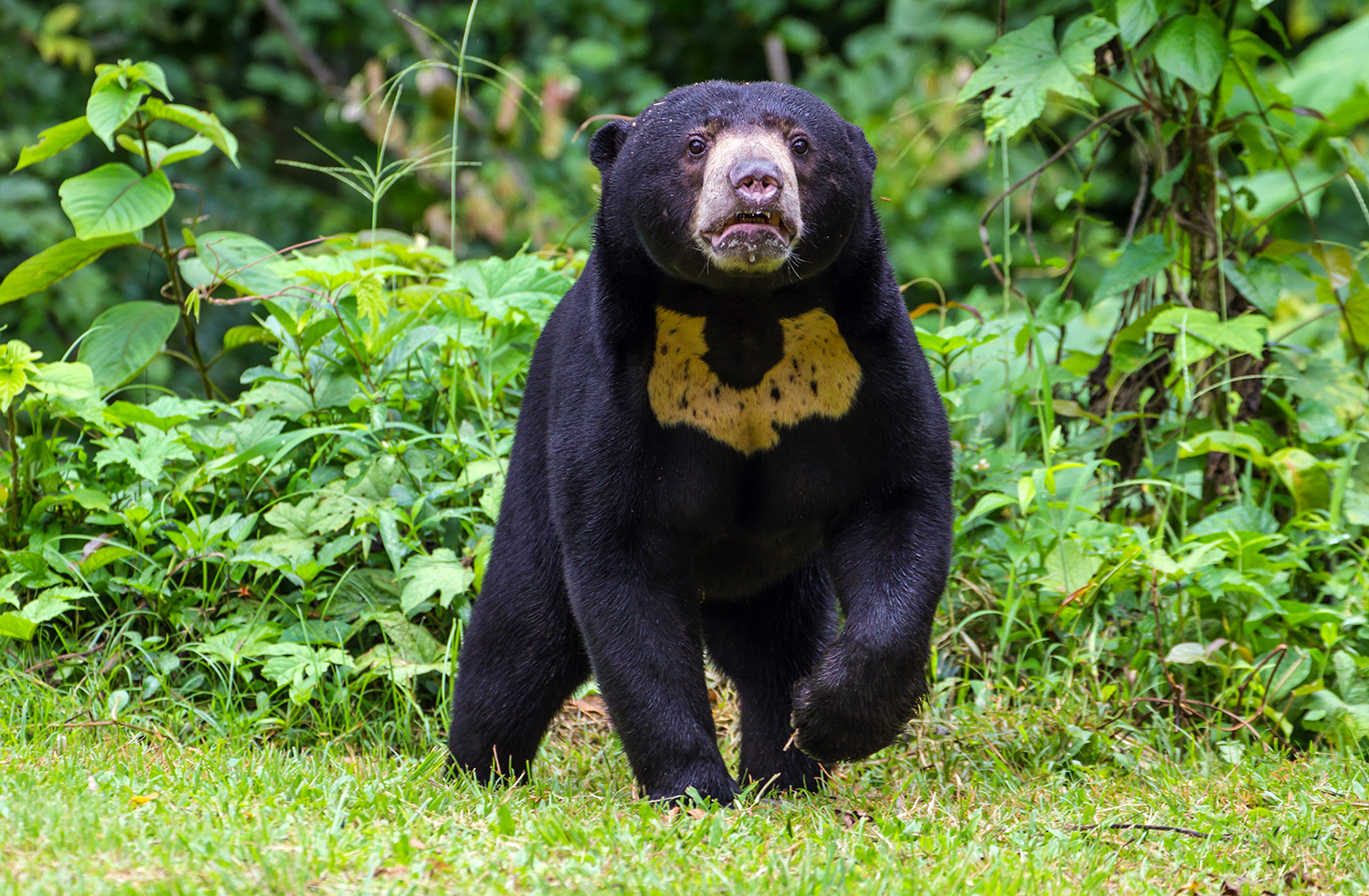
  • The sun bear gets its name from the bib-shaped golden or white patch of fur on its chest.
  • Sun bears help keep forests healthy by spreading seeds from the fruit they eat and by eating termites that can damage trees.
A sun bear stands on all fours in grass and looks at the camera.

© sirichai_raksue—iStock/Getty Images Plus

Sun bears are much smaller than grizzly bears.

Sun bears are threatened with extinction. In the past 30 years, their population is estimated to have fallen by about 30 percent because of deforestation and illegal hunting. Scientists aren’t sure how many sun bears are left, but estimates range from 1,000 to 2,500.

Conservationists are hoping that the viral video of Angela will help shed some light on the uncertain future of sun bears.

“Sun bears are extremely rare and close to extinction,” Bosco Chan, conservation director at the World Wildlife Fund, told CNN. “Their forest habitats, where destruction…remains rampant, must be strictly protected.”

NEWS EXTRA

World Cup Winners!

Women in red, yellow, and black uniforms pose and cheer with their arms up as one woman holds a trophy.

Catherine Ivill/Getty Images Sport

Ivana Andrea of Spain lifts the FIFA Women’s World Cup Trophy as her team celebrates their World Cup win.

Spain has won the 2023 Women’s World Cup! On Sunday, August 20, the Spanish team scored a 1-0 victory over England, thanks to Olga Carmona’s first-half goal. Carmona had also scored the game-winning goal in Spain’s 2-1 semifinal win over Sweden. 

It was a comeback story for Spain, which lost to England at the 2022 European Championship. 

“I think all of us, we felt that this team had something special,” Carmona told the Associated Press. “We’ve been fighting until the end. We never stopped.

Did You Know?

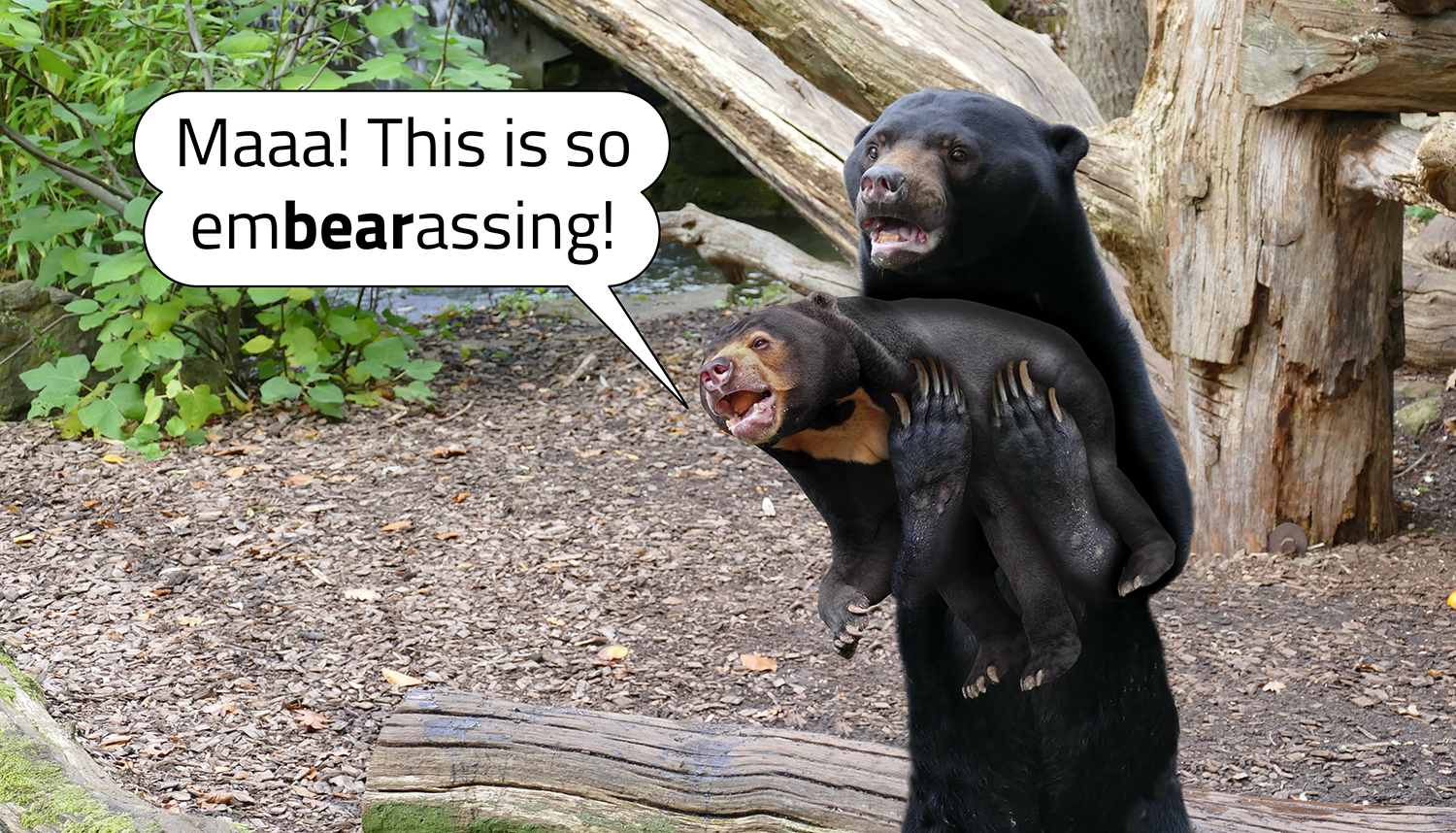
A sun bear carries a sun bear cub as a speech bubble says Ma, this is embarrassing.

© Tanja/stock.adobe.com, © Lukas Blazek/Dreamstime.com; Photo illustration Encyclopædia Britannica, Inc.

Sun bears have been seen cradling their cubs in their arms (much like humans carry their babies) while walking on their hind legs.

Bear vs. Bear

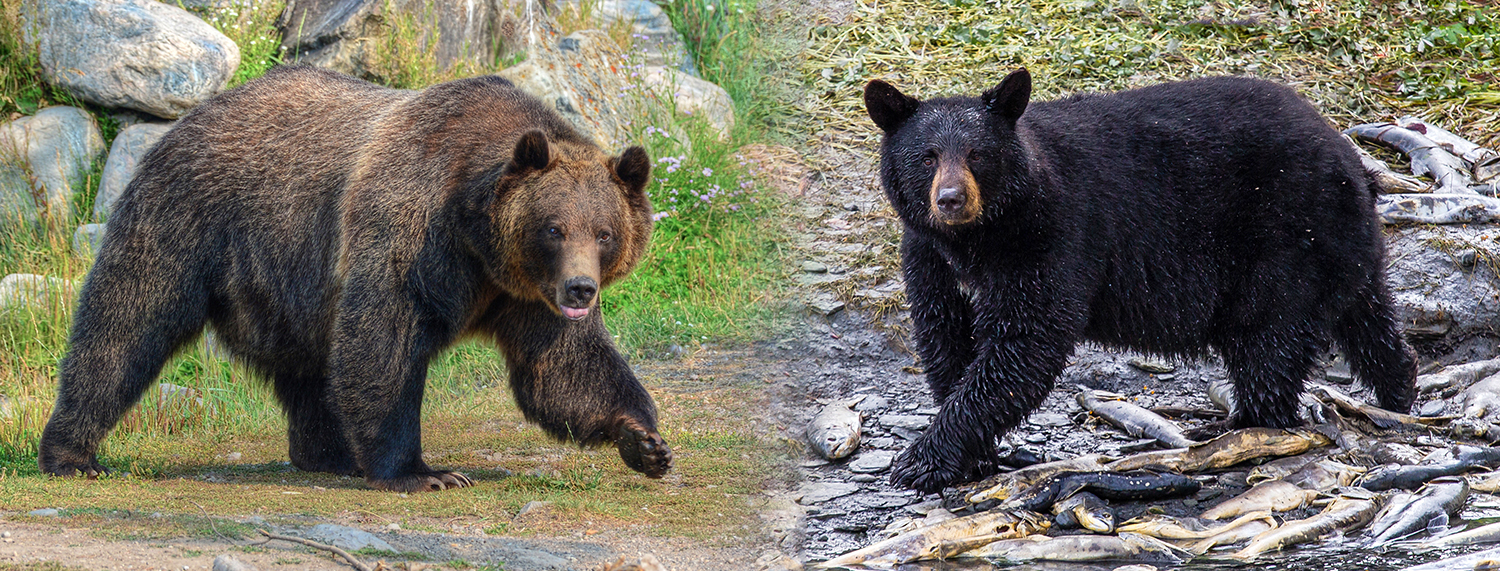
Side by side images of a grizzly bear and a black bear.

© Paul, troutnut/stock.adobe.com; Photo composite Encyclopædia Britannica, Inc.

Some bear species are harder to identify than others. Most people know a panda bear’s distinctive look, but it can be more difficult to tell a grizzly bear (otherwise known as a brown bear) from an American black bear. You can’t go by fur color. Confusingly, some black bears are actually brown!

So, how can you tell these two species apart? Here are some key differences.

Grizzly Bear

  • It stands 3 to 5 feet (0.9 to 1.5 meters) at the shoulder. 
  • It has a hump at the shoulder.
  • Its rear end is lower than the shoulder hump.
  • Its ears are short and round.
  • Its front claws are slightly curved and 2 to 4 inches (5 to 10 centimeters) long.
  • Claw marks are often visible in its tracks.

American Black Bear

  • It stands 2 to 3.5 feet (0.6 to 1.0 meters) at the shoulder.
  • Its shoulders are level or flat with its back.
  • Its rear end is higher than its shoulders.
  • Its ears are tall and oval shaped.
  • Its front claws are curved and less than 2 inches (5 centimeters) long.
  • Claw marks are not always visible in its tracks.

The Bear Facts

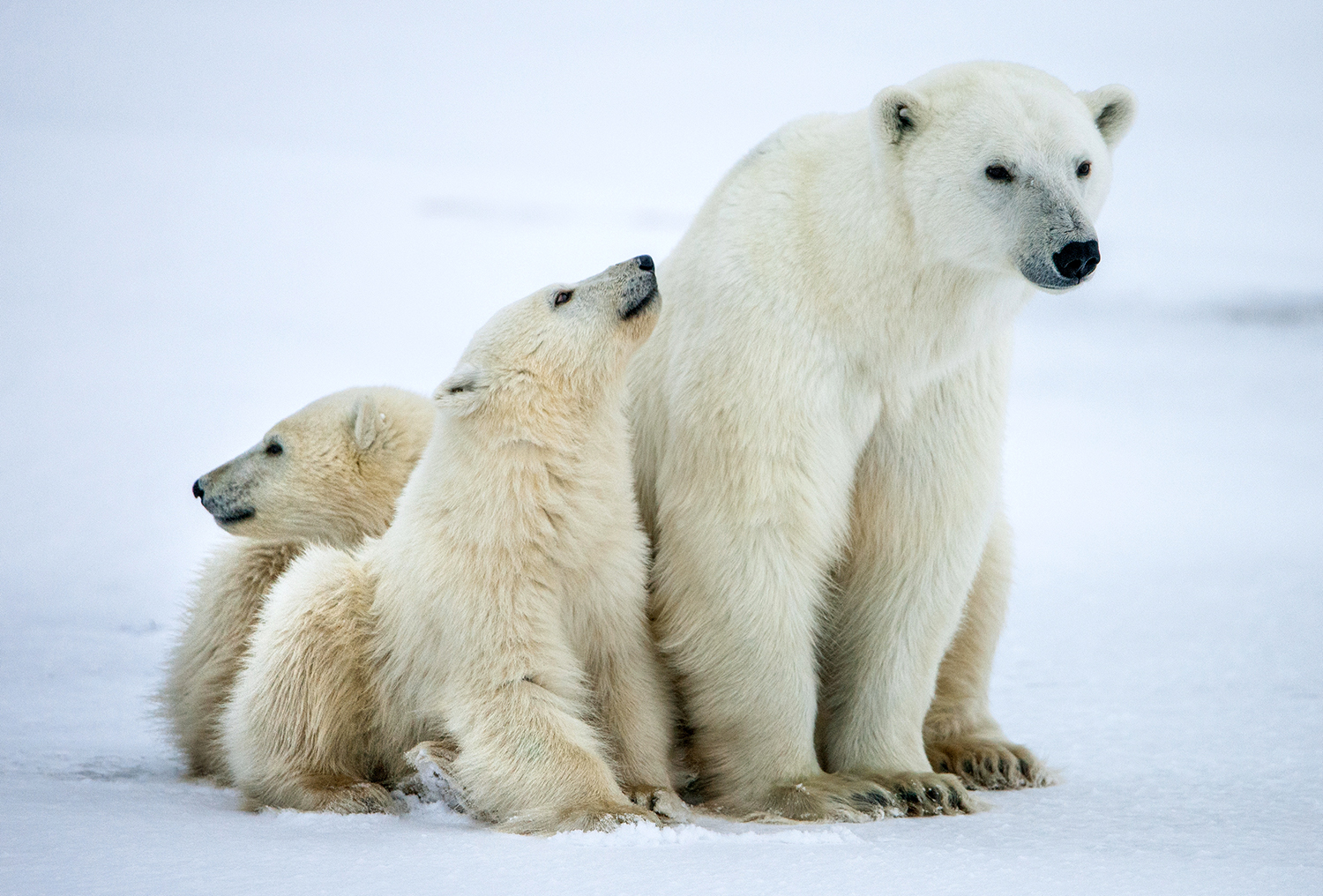
A polar bear and two cubs sit on ice.

© Uryadnikov Sergey/stock.adobe.com

Can bears run and climb trees? Do they really sleep all winter? And what on Earth is a sloth bear?

Find the answers to these questions and more at Britannica School!

WORD OF THE DAY

anthropomorphic

PART OF SPEECH:

adjective

Definition:

: described or thought of as being like human beings in appearance, behavior, etc.

Definitions provided by
Merriam-Webster Logo

Wordrow

O
O
O
O
O
O

In Case You Missed It

The island of Corsica showed American colonists that a courageous revolution could defeat an empire.
May 7, 2026
Physicist Narinder Singh Kapany developed fiber optic cables, helping to make the Internet possible.
April 30, 2026
How can you tell whether photos and videos are real or made with AI? Here are a few tips.
April 24, 2026
A seemingly strange bank is saving one of Earth’s most valuable resources.
April 9, 2026

Chef’s Creations Celebrate Mexico

A woman in an apron poses in front of a painting.

Chef’s Creations Celebrate Mexico

Chef Elena Reygadas explores Mexican history and culture through food.

A woman in an apron poses in front of a painting.

Maureen Evans

Elena Reygadas has been named the world’s best female chef.

Food isn’t just something that fills our bellies. A country’s cuisine can tell us a lot about its history and culture. Chef Elena Reygadas understands this well. In 2023, her commitment to showing off Mexico’s many flavors won her the World’s Best Female Chef award from the website World’s 50 Best Restaurants.

Reygadas owns and runs four businesses in Mexico City, Mexico. There’s Rosetta Bakery, a casual restaurant called Lardo, and a bistro (a type of small restaurant) called Café Nin. Her most celebrated eatery is called Rosetta. There, she cooks with a mixture of Mexican ingredients that reflect Mexico’s past and present.

Some of these ingredients have been used for hundreds of years. They were eaten by Indigenous people long before the Spanish arrived in Mexico in the 1500s. Reygadas says she uses as many Mexican ingredients as she can in order to keep them alive and in use for as long as possible. From these and more modern ingredients, Reygadas has created a rich menu, including dishes like savoy cabbage tacos with pistachio pipián sauce, sweet potato ravioli with matcha, and corn tamales with smoked cream.

Reygadas tries to use ingredients that are naturally grown in each season. And that means her menu changes a lot. “It makes us sad because we became very attached to the ingredients, but that also allows us to continue our creativity and move into a new moment,” she told NBC News.

Reygadas says the climate crisis is changing the way we eat. As a chef, it’s hard not to be aware of this. “For example, last year we had very few wild mushrooms because rainfall was scarce due to climate change,” she told NBC News. “And that is very sad and serious.”

Food is connected to so many things. But Reygadas says her main goal is very simple. She wants her creations to make people feel good.

Six panel image of different food dishes.

Maureen Evans, Ana Lorenzana; Photo composite Encyclopædia Britannica, Inc.

A sampling of Chef Elena Reygadas’s creations.

Did You Know?

© Sebastian Duda/stock.adobe.com

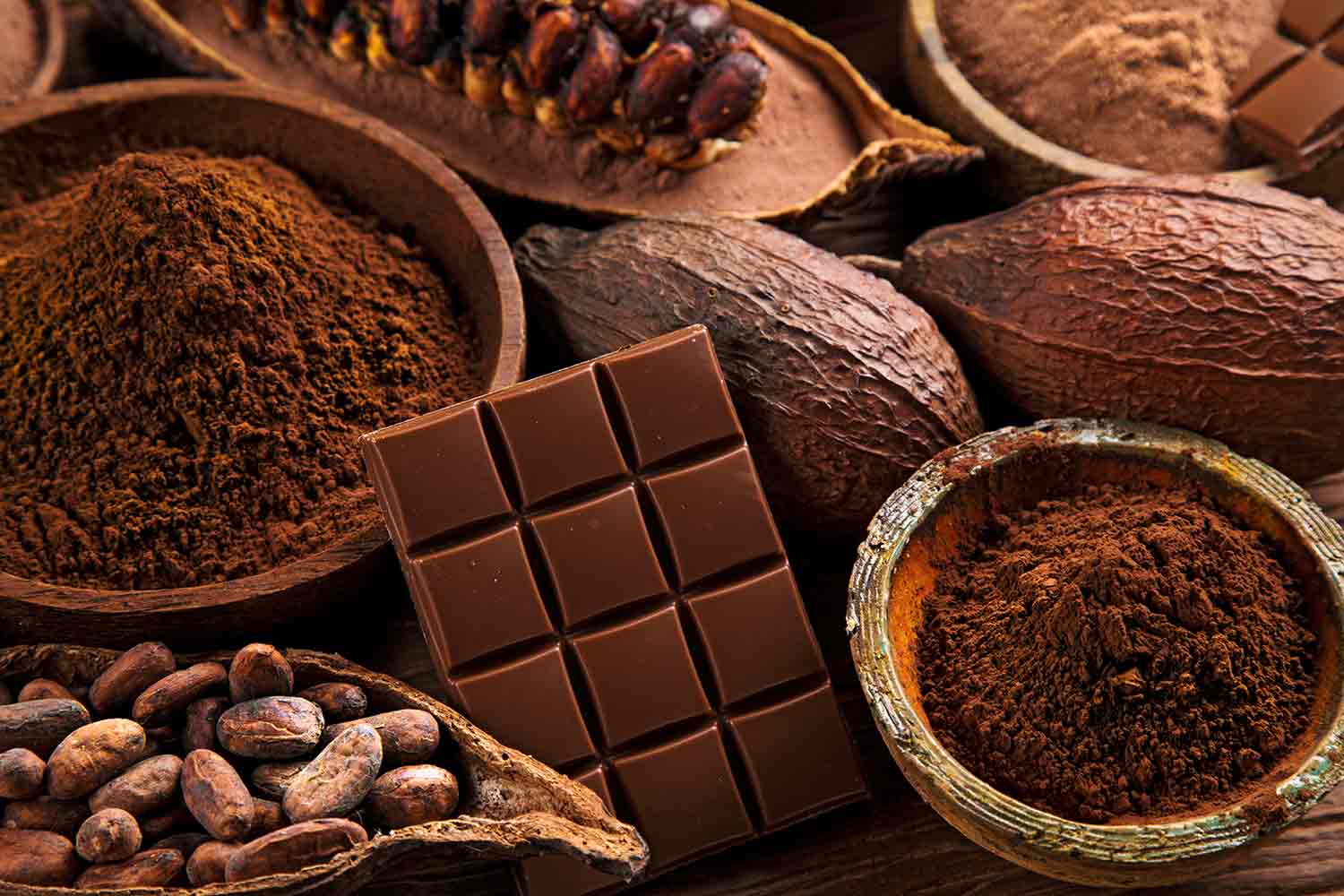
Many foods eaten all over the world originated in what is now Mexico. People in this part of the world have prepared food with corn, avocados, and cocoa beans (which are used to make chocolate) for thousands of years.

Celebrating Hispanic and Latino Heritage

September 15 to October 15 is National Hispanic Heritage Month in the United States. Let’s celebrate just a few Hispanic and Latino Americans who have had a major impact in their fields.

Minoso at bat

The Stanley Weston Archive/Getty Images

Minnie Miñoso was the first Black major league baseball star from Latin America. Born in Cuba in 1925, Miñoso came of age at a time when the sport of baseball was racially segregated in the United States. Players who weren’t white were not permitted to play in the major leagues. When he arrived in the U.S. in 1945, Miñoso played for the Negro Leagues. In 1949, after Jackie Robinson helped desegregate baseball, Miñoso became a major league ball player. Miñoso led the American League in stolen bases and triples three times, won three Gold Glove awards, and was a seven-time All-Star.

Mendez smiles as a medal is placed around her neck.

Alex Wong/Getty Images

In the 1940s, Sylvia Mendez was at the center of a court case about school segregation after she was not allowed to attend an all-white school in California. Her family’s 1946 victory in the case paved the way for the 1954 case Brown v. Board of Education, where the Supreme Court ruled that racial segregation in public schools is unconstitutional. Today, Sylvia Mendez is a civil rights activist who educates others about her legal case.

Alvarez poses outdoors in coat, hat, and sunglasses.

Jackson Leibach/University of Kansas, reproduced with permission by Robert DePalma

Along with his father, geologist Walter Alvarez developed the theory that, about 66 million years ago, an asteroid collided with Earth, causing a mass extinction that included the dinosaurs. Since the 1980s, when Alvarez advanced this theory, evidence to support it has grown.

Pam Muñoz Ryan (born 1951).

Portrait of smiling Ryan

Courtesy of Pam Muñoz Ryan

Pam Muñoz Ryan’s books for young readers often include elements from her Mexican-America background. Her 2000 novel, Esperanza Rising, is based on her Mexican grandmother’s experiences working at a labor camp in the 1930s. Muñoz Ryan is also the author of Echo, a 2015 Newbery Honor book about a magical harmonica that travels through time and forms a bond between three strangers.

Hispanic Heritage Month

Images of Hispanic and Latino figures and cultural traditions flash on and off the screen.

© Keith Dannemiller/Alamy, © Sundry Photography, Kobby Dagan//Shutterstock.com, © Carlos R, Julio/stock.adobe.com, © Jinlide/Dreamstime.com, Laurence Griffiths, Focus on Sport/Getty Images, Steve Petteway/Collection of the Supreme Court of the United States, Centers for Disease Control and Prevention

Hispanic Heritage Month begins on September 15. You can read about Hispanic and Latino Americans from all walks of life at Britannica School!

WORD OF THE DAY

gastronomy

PART OF SPEECH:

noun

Definition:

: the art or activity of cooking and eating fine food

Definitions provided by
Merriam-Webster Logo

Crossword

Answer the clues and fill in the puzzle.

O
O
O
O
O
O

In Case You Missed It

The island of Corsica showed American colonists that a courageous revolution could defeat an empire.
May 7, 2026
Physicist Narinder Singh Kapany developed fiber optic cables, helping to make the Internet possible.
April 30, 2026
How can you tell whether photos and videos are real or made with AI? Here are a few tips.
April 24, 2026
A seemingly strange bank is saving one of Earth’s most valuable resources.
April 9, 2026

Do Rats Like to be Tickled?

Three panels of a hand tickling a rat on its back and belly.

Do Rats Like to be Tickled?

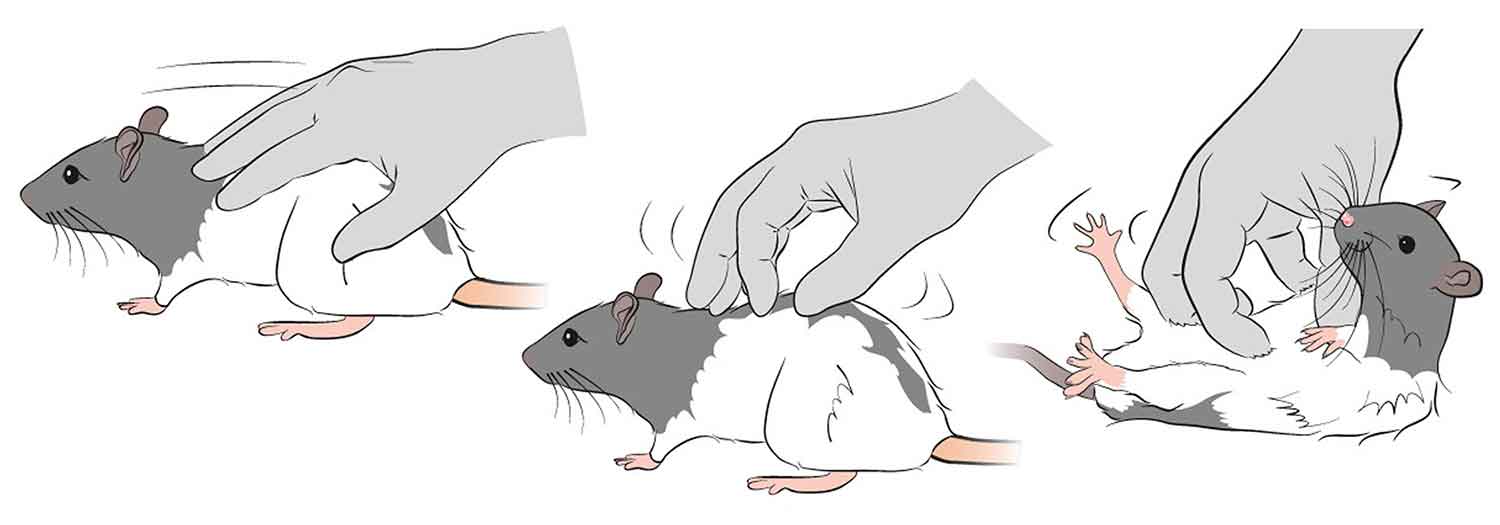
Researchers tickled rats to learn more about how animals respond to playful situations.

Three panels of a hand tickling a rat on its back and belly.

© Gloveli, SImonnet, Tang, et. al. “Play and tickling responses map to the lateral columns of the rat periaqueductal gray”. July 28, 2023.

Humans aren’t the only animals that play. Dogs play, many birds play…and even rats play. In a recent study, researchers wanted to learn more about how animals’ brains are linked to their love of play. So, they tickled rats.

Researchers at Humboldt University in Berlin, Germany, played with and tickled rats on their backs and bellies while observing the animals’ brain activity. They found that if the rats were in a good mood, they actually enjoyed being tickled. There were a couple of signs that the rats were having fun. For one thing, they would seek out more tickling by chasing the hand that had just tickled them. In addition, a microphone enabled researchers to hear the rats making playful chirping sounds that they compared to human giggles.

Scientists found that when the rats were stressed, they didn’t giggle as much in response to the tickling. Previous studies have shown that humans who are stressed also giggle less in response to tickling because (even though some of the laughter is involuntary) they’re not enjoying it.

Scientists think that learning about play and why it’s important could help expand their understanding of how the brain adapts to difficult situations. And knowing what sparks joy in the brain could be helpful in treating certain conditions, such as anxiety and depression.

Did You Know?

Dr. Marina Davila-Ross, University of Portsmouth

Scientists have found that great apes laugh when they’re tickled! Apes, which are highly social, may have developed tickling as a way to maintain their bonds with each other.

Rat Facts

A teen holds a gray and white rat in her hands.

© fizkes—iStock/Getty Images

There are 56 known species of rat in the world! Here’s a little more you might not know about rats.

  1. The Bozavi woolly rat is believed to be the largest species of rat. It’s about 32 inches (81 centimeters) long (including the tail) and weighs more than 3 pounds (1.4 kilograms). The common house rat weighs about 12 ounces (0.34 kilograms).

  2. Rats can start having litters when they are five weeks old!

  3. For a long time, scientists believed that rats were responsible for spreading a disease called the plague through Europe in the 1300s. Today, they believe the rodents that spread the plague were actually gerbils.

  4. Rats’ teeth never stop growing, so they need to gnaw constantly. Rats are famous for being able to chew through soft concrete, wood, plastic, and even cinder blocks.

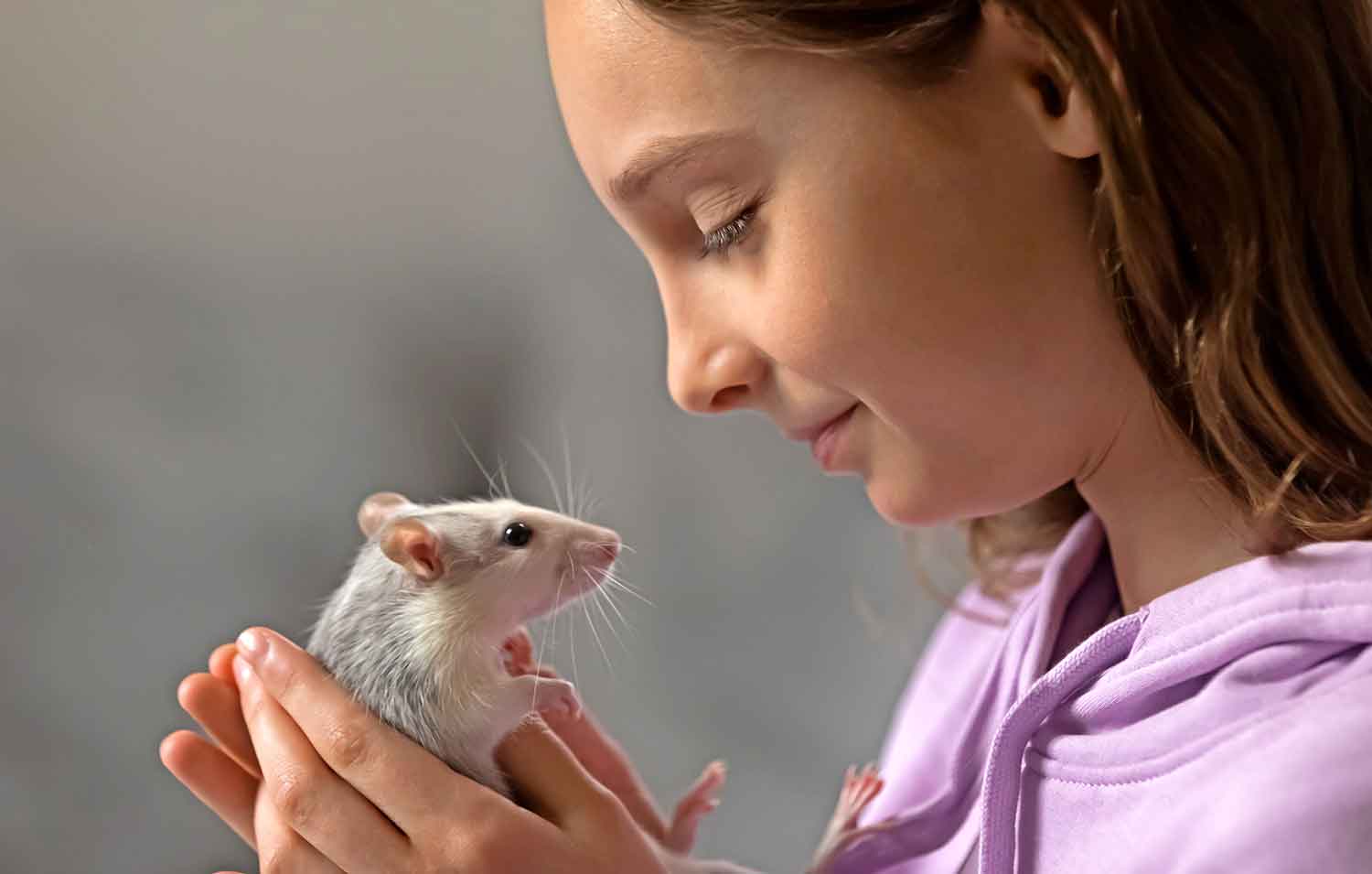
  5. Rats are intelligent and very social. For this reason, when rats are obtained from a responsible seller, they can make good pets.

Little Animals, Big Family

© Stan Tekiela, Author, Naturalist & Wildlife Photographer—Moment/Getty Images

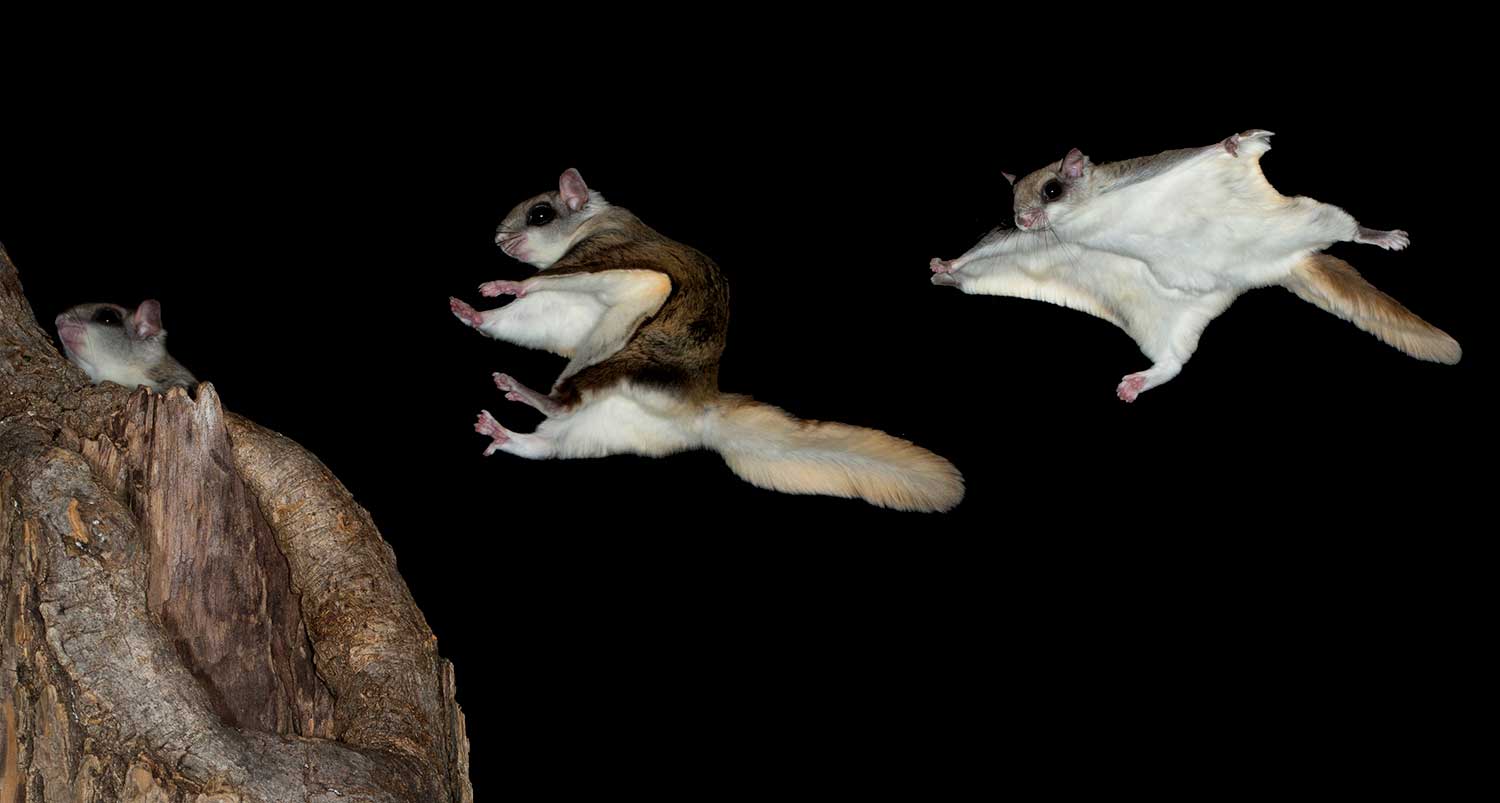
Yes, some squirrels can fly!

Rodents are everywhere! Well…not quite. There are a couple of places on Earth that are rodent free. Learn about this and more at Britannica School!

WORD OF THE DAY

cachinnate

PART OF SPEECH:

verb

Definition:

to laugh usually loudly or convulsively

Definitions provided by
Merriam-Webster Logo

Word Search

See if you can spot all the rodents running through this puzzle.

O
O
O
O
O
O

In Case You Missed It

The island of Corsica showed American colonists that a courageous revolution could defeat an empire.
May 7, 2026
Physicist Narinder Singh Kapany developed fiber optic cables, helping to make the Internet possible.
April 30, 2026
How can you tell whether photos and videos are real or made with AI? Here are a few tips.
April 24, 2026
A seemingly strange bank is saving one of Earth’s most valuable resources.
April 9, 2026

Will Flying Taxis Take Off?

A vehicle with six vertical propellers in flight over a coastline.

Will Flying Taxis Take Off?

A U.S. company is testing flying taxis. Would you ride in a flying car?

A vehicle with six vertical propellers in flight over a coastline.

Courtesy of Joby Aviation. © Joby Aero, Inc.

Joby’s flying vehicle is designed to operate as an air taxi for paying customers.

Instead of being stuck in traffic, what if you could fly over all those cars? That dream may soon become a reality. The U.S. government has just given a company called Joby Aviation permission to test flying taxis that may someday whisk people to and from airports.

The Federal Aviation Administration (FAA) has given Joby’s aircraft a Special Airworthiness Certificate. This means Joby is allowed to operate in U.S. airspace “for research and development purposes.” If all goes well, Joby hopes to begin selling rides in its flying vehicles in the United States in 2025.

Joby’s air taxis are what are known as eVTOL aircraft—eVTOL stands for “electrical vertical take-off and landing.” They run on electricity rather than gasoline, and they take off and land vertically, like helicopters. But Joby claims its aircraft are much quieter than helicopters. And since they run on electricity rather than gasoline, they’re greener than most cars.

Joby plans to create a ride-share service like Uber—customers would use an app to book a ride. But unlike Uber cars, Joby air taxis would be able to fly above traffic, getting customers to the airport fairly quickly. Companies in other countries, including Germany and the United Arab Emirates, are planning to launch similar services.

Some people have expressed concern that only the wealthy will be able to afford to use flying taxis. But Joby says the cost would be similar to the cost of an Uber or Lyft ride.

“Our goal is to actually be competitive with the cost of ground transportation, but to deliver you to your destination…five times faster and with a dramatically better experience,” Joby founder and CEO JoeBen Bevirt told Bloomberg TV. Before that can happen, Joby will need full certification from the FAA. 

The video below shows Joby’s aircraft in action.

Courtesy of Joby Aviation. © Joby Aero, Inc.

Check out the Joby air taxi in flight.

Did You Know?

© Archivist/stock.adobe.com; Animation Encyclopædia Britannica, Inc.

A taxicab is a vehicle (with driver) that customers hire to take them between any two points for a fee. People have been hiring vehicles in one form or another since the 1600s. The term cab comes from the cabriolet, a two-wheeled, one-horse carriage that was often hired in the 1800s.

The Future of Flying Cars

Copyright 2022, Samson Sky

Is this the flying car of your dreams?

Flying taxis may be in our immediate future. But what about flying cars for all? Decades ago, people envisioned a future in which highways stretched across the skies and regular drivers flew their vehicles around town. So why are we still grounded?

It turns out that several flying cars have already been invented. In 2022, for example, the Federal Aviation Administration approved a car called the Samson Sky Switchblade for test flights. The Switchblade looks like a regular car when it’s operated on the ground but can sprout wings and take flight. Two downsides are that it requires a runway for takeoff and will cost more than $100,000. Samson says many people have reserved cars—for whenever they’re available to buy. The video will give you an idea of how the Switchblade would work.

Copyright 2022, Samson Sky

So far, flying cars aren’t available to the public. Do you think the future will include skies full of flying cars?

Just Plug and Go!

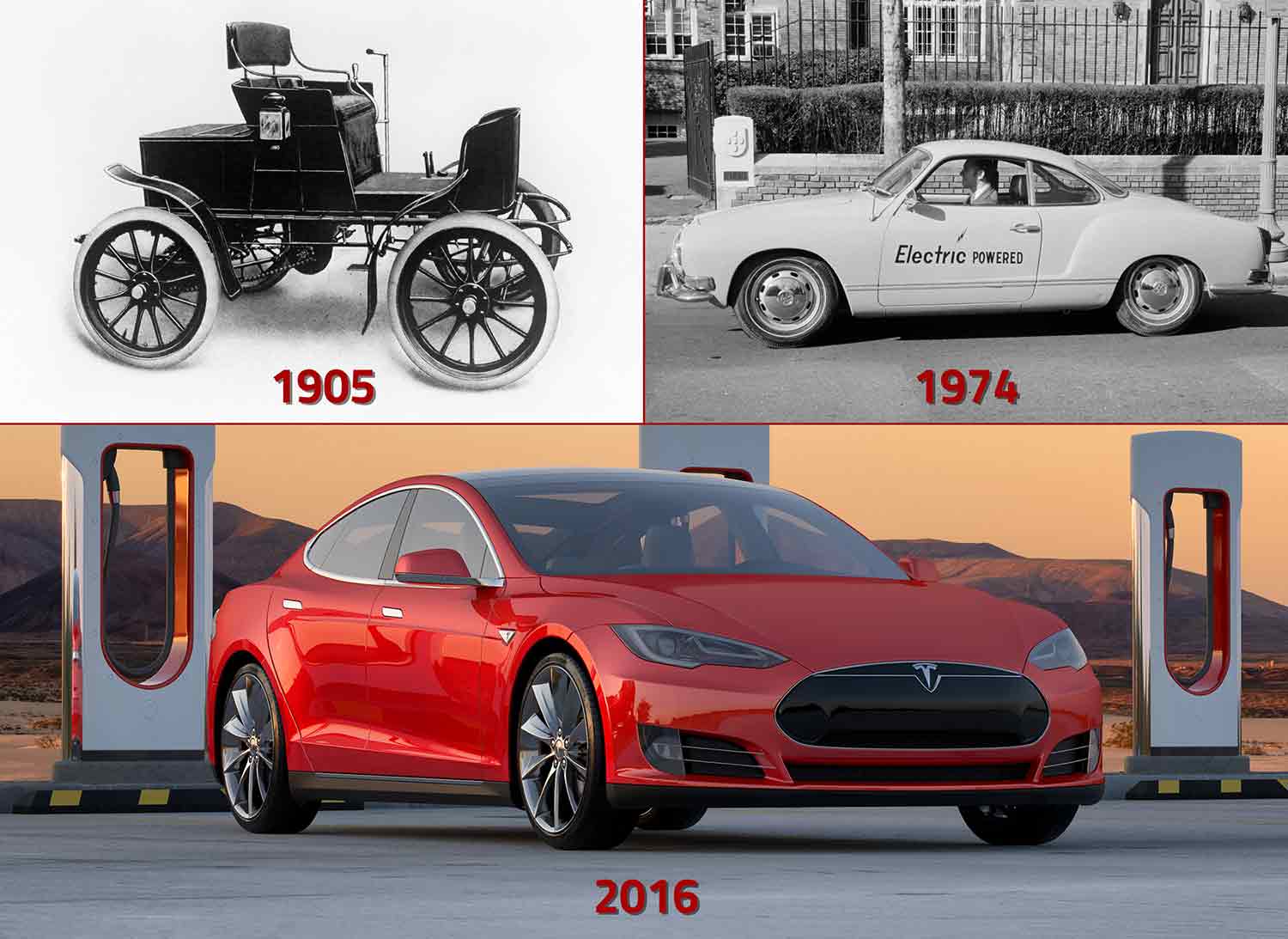
Electric cars from 1905, 1974, and 2016.

Encyclopædia Britannica, Inc., Library of Congress (LC-DIG-ppmsca-55465), © Mike Mareen/stock.adobe.com; Photo composite Encyclopædia Britannica, Inc.

Electric cars have included (from top left) the No. 9017 Studebaker Electric Trap from 1905, an electric car from 1974, and a Tesla Model S 85 from 2016.

Flying cars may be a long way off, but electric cars are already here. In fact, they’ve been here for quite a while. You can read more about them—and their surprisingly long history—at Britannica School.

WORD OF THE DAY

peripatetic

PART OF SPEECH:

adjective

Definition:

: going from place to place usually as part of your job

Definitions provided by
Merriam-Webster Logo

Word Search

See if you can find all the flying vehicles.

O
O
O
O
O
O

In Case You Missed It

The island of Corsica showed American colonists that a courageous revolution could defeat an empire.
May 7, 2026
Physicist Narinder Singh Kapany developed fiber optic cables, helping to make the Internet possible.
April 30, 2026
How can you tell whether photos and videos are real or made with AI? Here are a few tips.
April 24, 2026
A seemingly strange bank is saving one of Earth’s most valuable resources.
April 9, 2026

Drones Eye Shorelines for Sharks

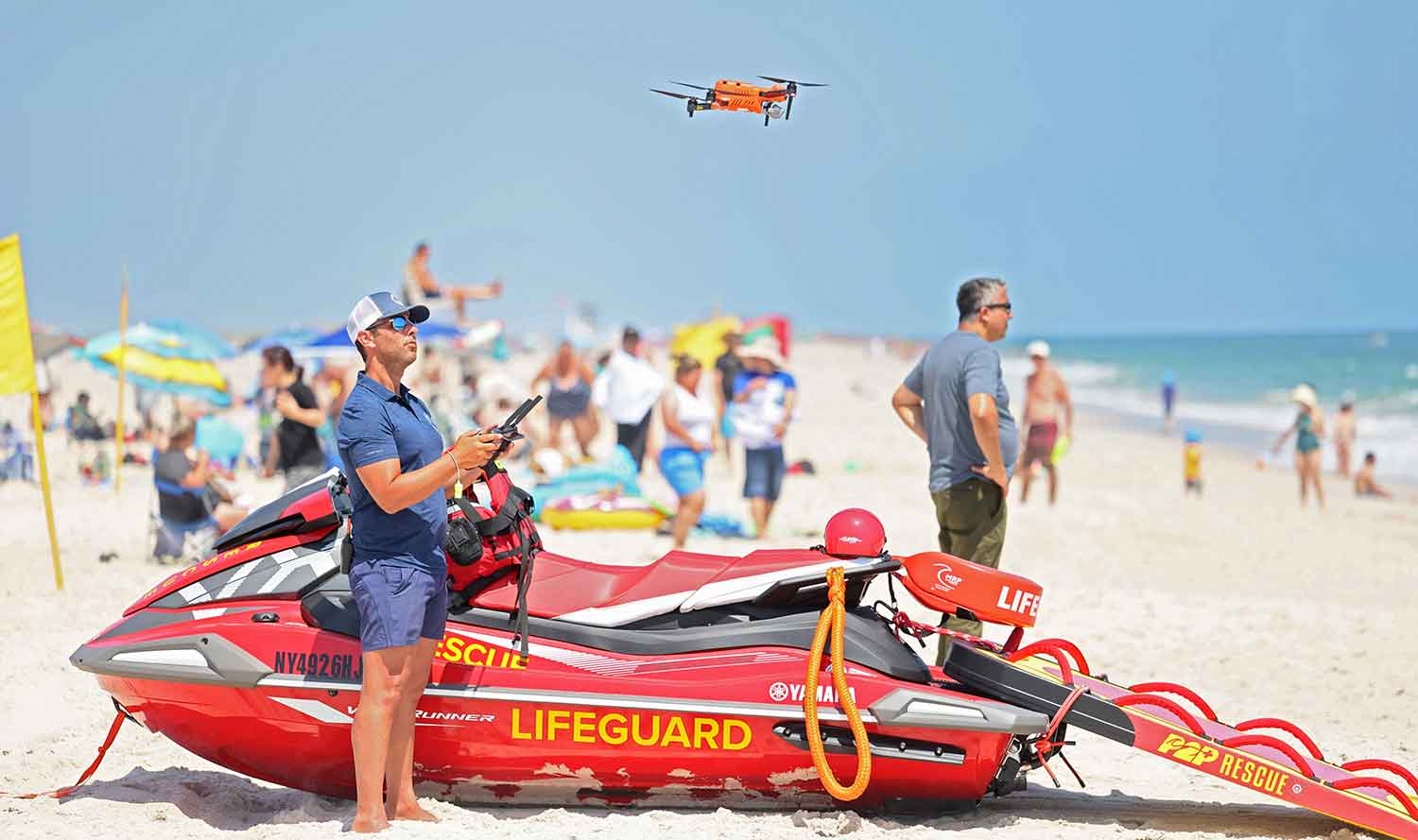
A man on a beach stands in front of a red jet ski that says Lifeguard as he operates a drone that is flying nearby.

Drones Eye Shorelines for Sharks

Officials are using drones to check the waters near beaches for the presence of sharks.

A man on a beach stands in front of a red jet ski that says Lifeguard as he operates a drone that is flying nearby.

Michael M. Santiago/Getty Images News

Lifeguard supervisor Cary Epstein operates a shark-monitoring drone at Jones Beach State Park in New York.

At beaches along the coast of New York state, unpiloted flying vehicles called drones sweep over the shoreline. Officials are using cameras on the drones to capture footage of what’s under the water. Specifically, they’re looking for sharks.

Sharks have always come close to shorelines, but in the summer of 2023, there’s been a higher-than-average number of human-shark encounters. Climate change has warmed the North Atlantic Ocean, making it more hospitable to sharks. And, in New York, state laws now protect bunker fish, a staple of the shark diet, making them more plentiful.

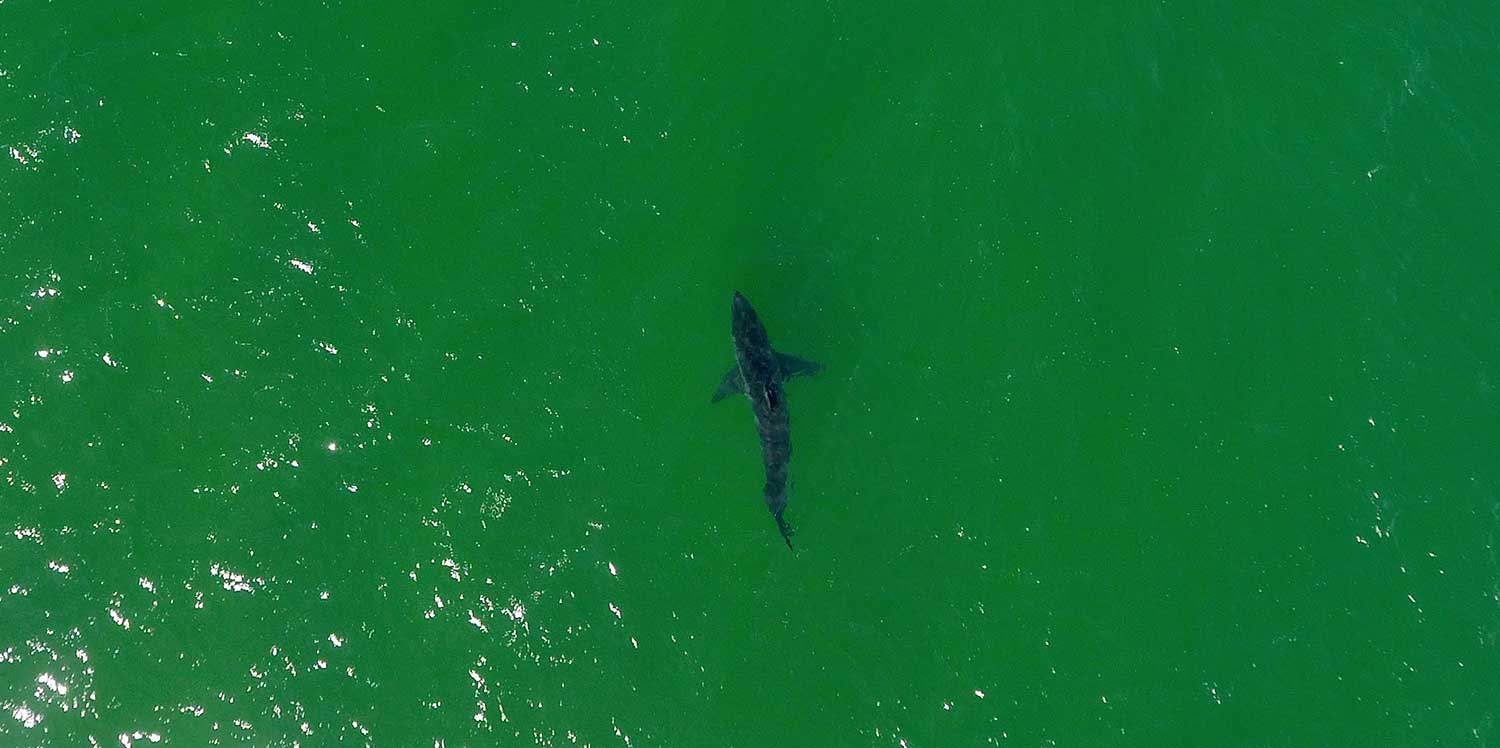
Aerial view of a shark swimming in green water.

© Christopher Seufert/Dreamstime.com

This aerial photo of a shark was taken off the coast of Cape Cod, Massachusetts.

Officials say beachgoers shouldn’t fear sharks. Shark bites are extremely rare. When they do happen, they’re usually not deadly, and they are often the result of encounters with smaller shark species, not the great white sharks that many people fear. Sharks can mistake a person for their usual prey.

Still, the state of New York has decided to use drones to help protect swimmers and surfers. In July 2023, New York governor Kathy Hochul announced a program that would provide 42 new drones to monitor beaches for shark activity. Some people object to drone use, saying that footage of sharks near shorelines can spark fear.

“Everybody that’s seeing a shark now is documenting it and can blast it onto the Internet on social media, and millions of people can see it,” Frank Quevedo, the executive director of the South Fork Natural History Museum in Bridgehampton, New York, told the BBC (British Broadcasting Corporation). “So people demonize sharks, saying, ‘Oh, they’re in our waters, they’re going to kill people.’”

But others argue that drones can make people feel safer. When police and other officials learn from drone footage that sharks are swimming near a beach, they can order everyone out of the water as a precaution. Plus, footage can reveal that sharks are less aggressive than many people think. In fact, some drone footage shows sharks swimming peacefully a short distance away from surfers. They’re not interested in the surfers.

Cary Epstein is a lifeguard supervisor at Jones Beach in New York, where drones are used to monitor the shoreline. Epstein says people shouldn’t be afraid, but they should understand that the sharks are just being sharks.

“People swim in the ocean every day, and they have for centuries,” Epstein told the Associated Press. “But we do have to remember that we are cohabitating [with sharks], and this is their house.”

Did You Know?

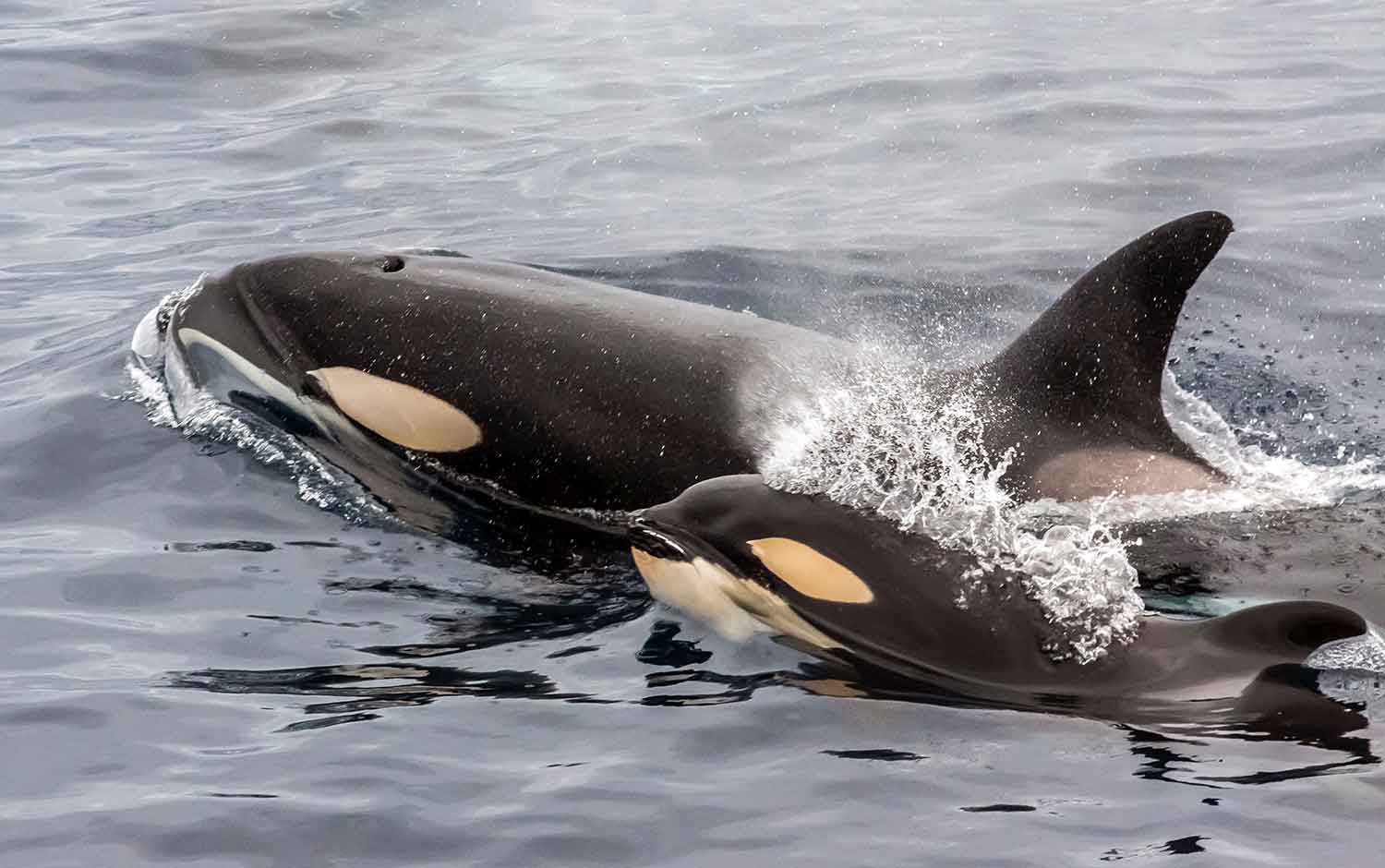
An adult orca and an orca calf swim side by side.

robertharding/Alamy

With about 300 knife-like teeth, great white sharks might seem like they rule the oceans. But they do have one natural predator: orcas. Orcas, also called killer whales, have been known to attack and eat great white sharks.

Are Sharks Really Movie Monsters?

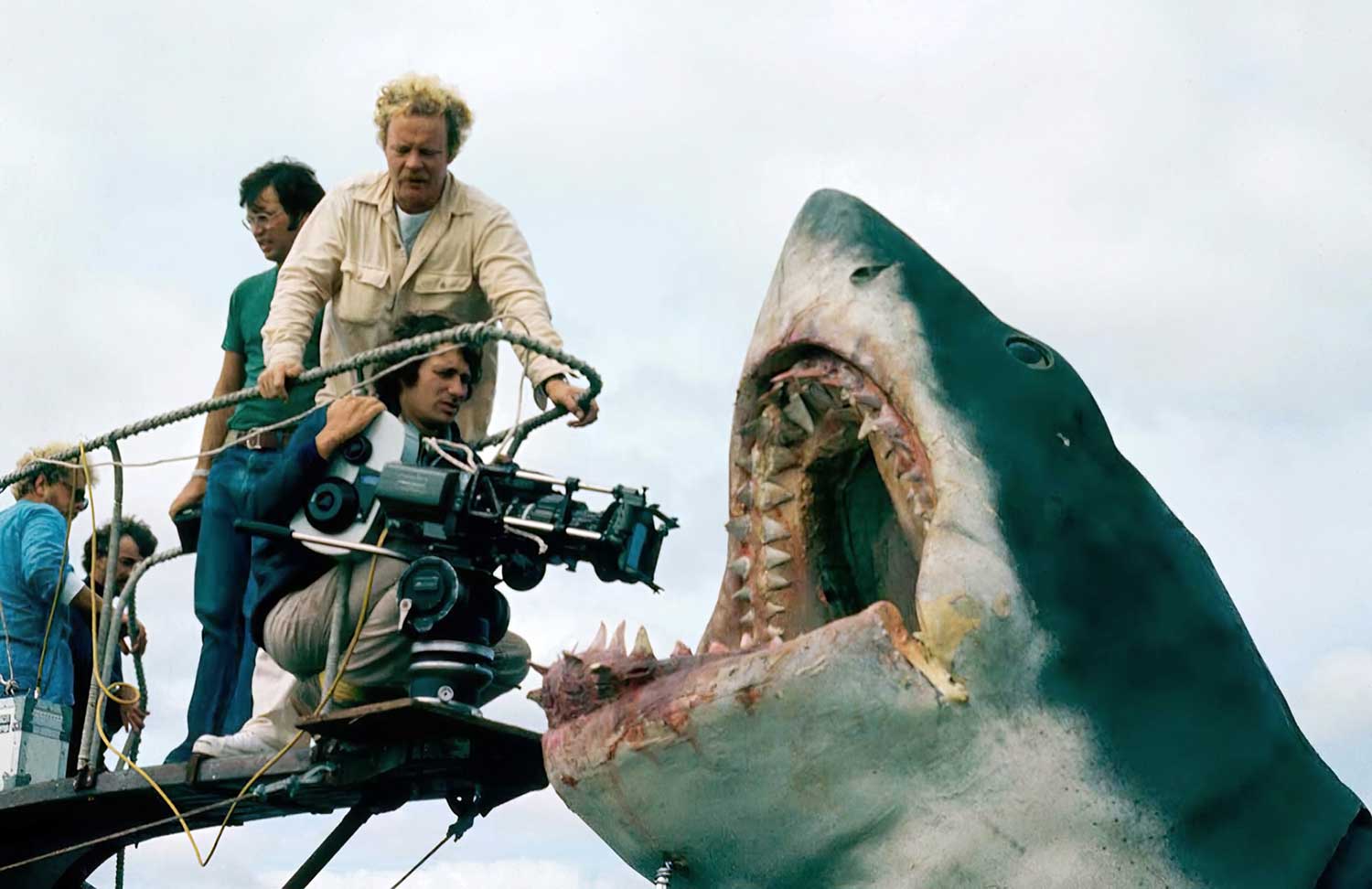
Steven Spieberg crouches on a crane pointing a camera into the mouth of a fake shark as four other men stand behind him.

© 1975 Universal Pictures Company, Inc.

Steven Spielberg (seen here holding the camera) directed the 1975 hit movie Jaws.  (Don’t worry. The shark is fake!)

A great white shark had a starring role in one of the biggest movies ever. Released in 1975, Jaws was about a gigantic great white that terrorizes swimmers at a beach in the northeastern U.S. The movie was a huge hit. So was the novel it was based on. But was Jaws fair to sharks?

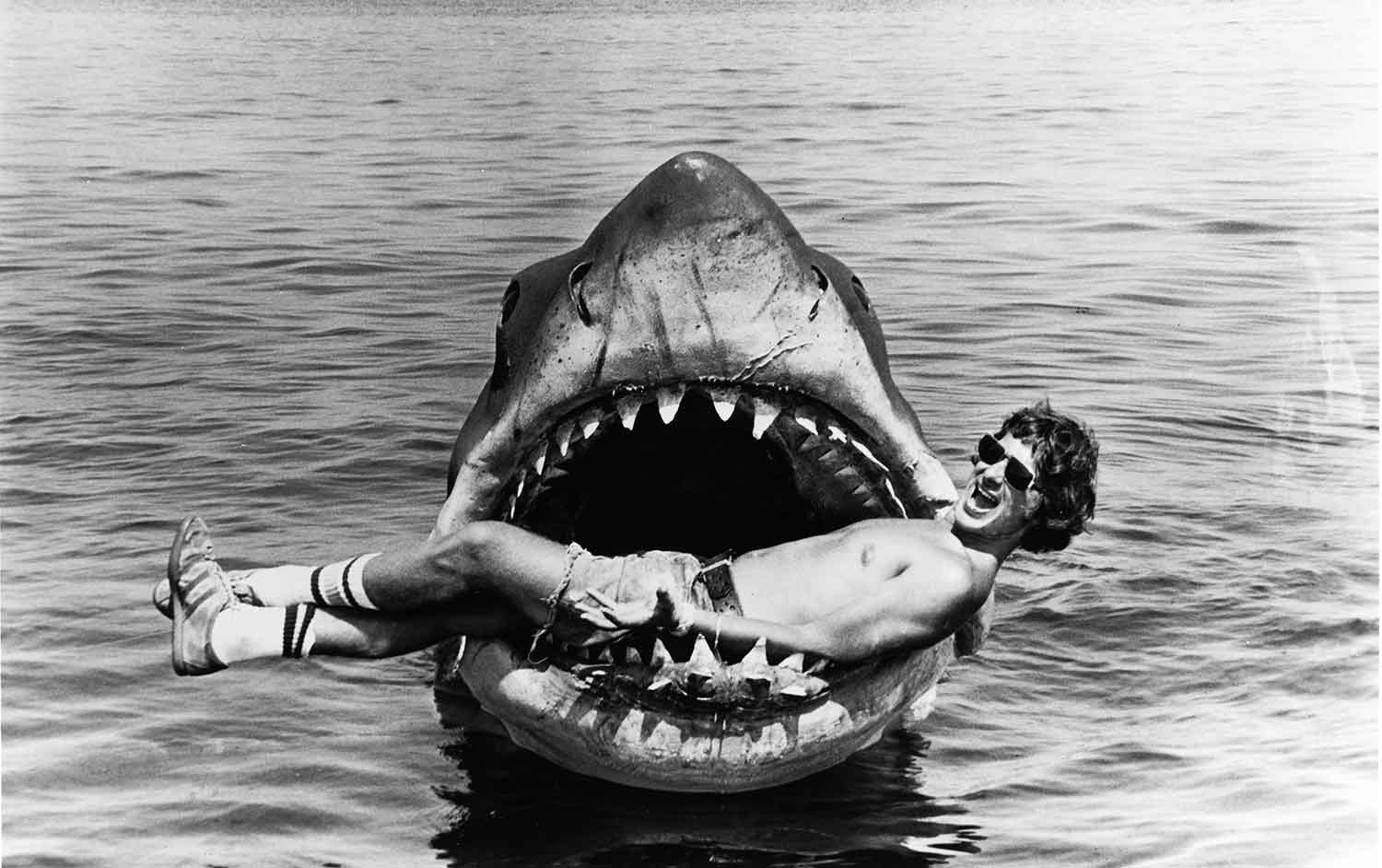
Steven Spielberg doesn’t think so. Spielberg directed Jaws, but in a 2022 interview, he said he later realized that the movie gave sharks an unfair reputation as horrible monsters. After the Jaws movie came out, sharks were fished at a rate that caused their population to decline.

“I truly…regret the [destruction] of the shark population because of the book and the film,” Spielberg told BBC Radio 4.

© 1975 Universal Pictures Company, Inc.

Steven Spielberg having some fun with a fake shark on the set of Jaws.

Scientists say sharks aren’t a great threat to humans—but humans continue to be a threat to sharks. Peter Benchley, the author of Jaws (the novel), pointed this out in 2006.

“There’s no such thing as a rogue man-eater shark,” Benchley told the London Daily Express. “In fact, sharks rarely take more than one bite out of people, because we’re so lean and unappetizing to them.”

Sink Your Teeth Into This!

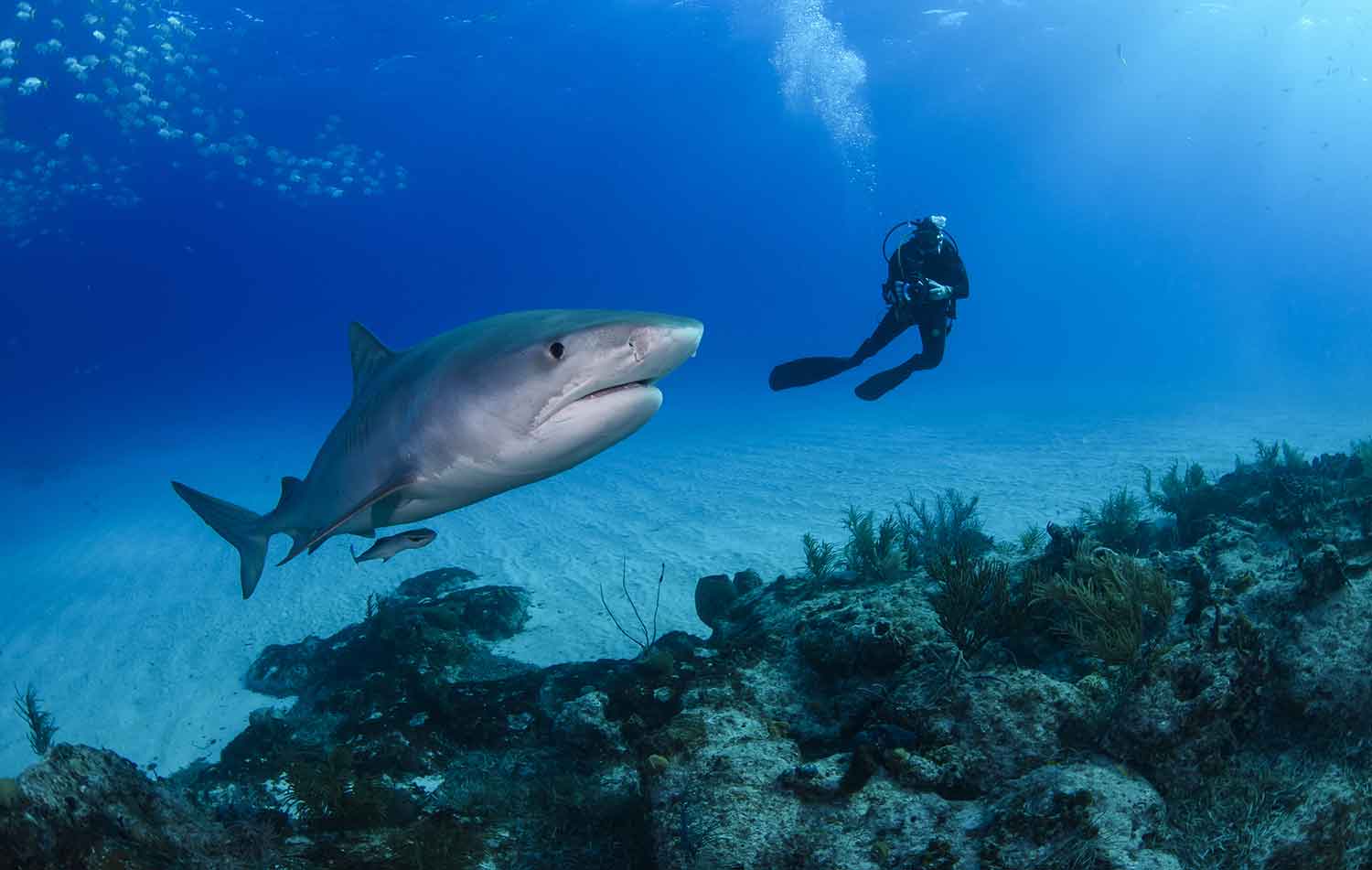
A diver in scuba gear swims alongside a tiger shark.

© Martin Voeller/Dreamstime.com

You can read more about sharks, and watch videos of shark activity, at Britannica School!

WORD OF THE DAY

brouhaha

PART OF SPEECH:

noun

Definition:

great excitement or concern about something

Definitions provided by
Merriam-Webster Logo

Wordrow

O
O
O
O
O
O

In Case You Missed It

The island of Corsica showed American colonists that a courageous revolution could defeat an empire.
May 7, 2026
Physicist Narinder Singh Kapany developed fiber optic cables, helping to make the Internet possible.
April 30, 2026
How can you tell whether photos and videos are real or made with AI? Here are a few tips.
April 24, 2026
A seemingly strange bank is saving one of Earth’s most valuable resources.
April 9, 2026

It’s All in the Paint

Light from a smiling Sun wearing sunglasses beats down on white rooftops and then bounces off.

It’s All in the Paint

A newly developed white paint can keep buildings cooler by reflecting nearly all of the Sun’s rays.

Light from a smiling Sun wearing sunglasses beats down on white rooftops and then bounces off.

© Marrishuanna, Natthaya Phiban/Dreamstime.com; Animation Encyclopædia Britannica, Inc.

Did you know that the temperature of a building is affected by the color of its roof? Lighter colors reflect much of the Sun’s heat, while darker colors absorb it. With that in mind, a scientist at Purdue University in Indiana has invented a new white paint that’s designed to keep a building cooler, just by coating its roof.

White roofs aren’t a new idea. In fact, they’re widely used in many cities that experience hot temperatures because they’re known to decrease the need for air-conditioning. But most white paint reflects about 80 to 90 percent of the Sun’s rays. The rest of those rays are absorbed into the building.

A few years ago, Xiulin Ruan, a professor at Purdue University, set out to make a more reflective white paint. “We wanted to help with climate change, and now it’s more of a crisis, and getting worse,” Ruan told the New York Times. “We wanted to see if it was possible to help save energy while cooling down the Earth.”

It’s a welcome development at a time when record-breaking heat waves in North America, Europe, and Asia have made headlines.

The paint that Ruan and a team of scientists developed reflects more than 98 percent of the Sun’s rays. At midday, a surface that’s been covered with the paint remains up to 8 degrees Fahrenheit (4.5 degrees Celsius) cooler than the air that surrounds it. At night, it’s up to 19°F (10°C) cooler. According to Ruan, the paint can decrease the need for air-conditioning by up to 40 percent.

The Purdue scientists achieved this level of reflectiveness by making the paint from a very reflective compound called barium sulfate. One downside is that barium sulfate must be mined, which is bad for the environment. But Ruan pointed out that most paint is made with titanium dioxide, which also has to be mined.

On the plus side, the new paint could help address some of the effects of climate change, provided it’s used widely enough, by reflecting those warming solar rays back into space. Ruan and his team have since developed a thinner form of the paint that can be used on airplanes, cars, and other vehicles to reduce the need for air-conditioning, even if they’re sitting on a hot tarmac or in a sizzling parking lot.

So, when can people go out and buy the ultra-reflective white paint? Ruan says he hopes it will be available as soon as 2024.

Did You Know?

© Christian Delbert, Artinspiring, Ramcreativ/Dreamstime.com; Animation Encyclopædia Britannica, Inc.

An air conditioner can cool a home to only about 15 to 20 degrees below the outside temperature.

Keeping Your Cool in the Summer

© New Africa/stock.adobe.com

Is your home sweltering in the summer? Before you crank up the air-conditioning (if you’re lucky enough to have air-conditioning, that is), check out these tips for beating the heat at home.

    • If you have a ceiling fan, use it! Ceiling fans don’t actually cool the air, but they can make a room feel cooler. Most ceiling fans have a switch at the base that allows you to change the direction they spin. (Turn the fan off before you change its direction.) It’s important to make sure the fan’s blades are moving counterclockwise in the summer, creating a downward breeze.
    • Close blinds and curtains. Sure, afternoon sunlight can make a room feel toasty in the winter. But that heat becomes a lot less welcome in July. In the summer, be sure to close your blinds or curtains before the Sun has a chance to heat things up. It also helps to put plants in front of windows that get a lot of sunlight.
    • If the evenings or early mornings are fairly cool, take advantage! Open the windows, if possible, but be sure to close them before the day heats up. You can also put a box fan in the window to help bring that cool air inside.
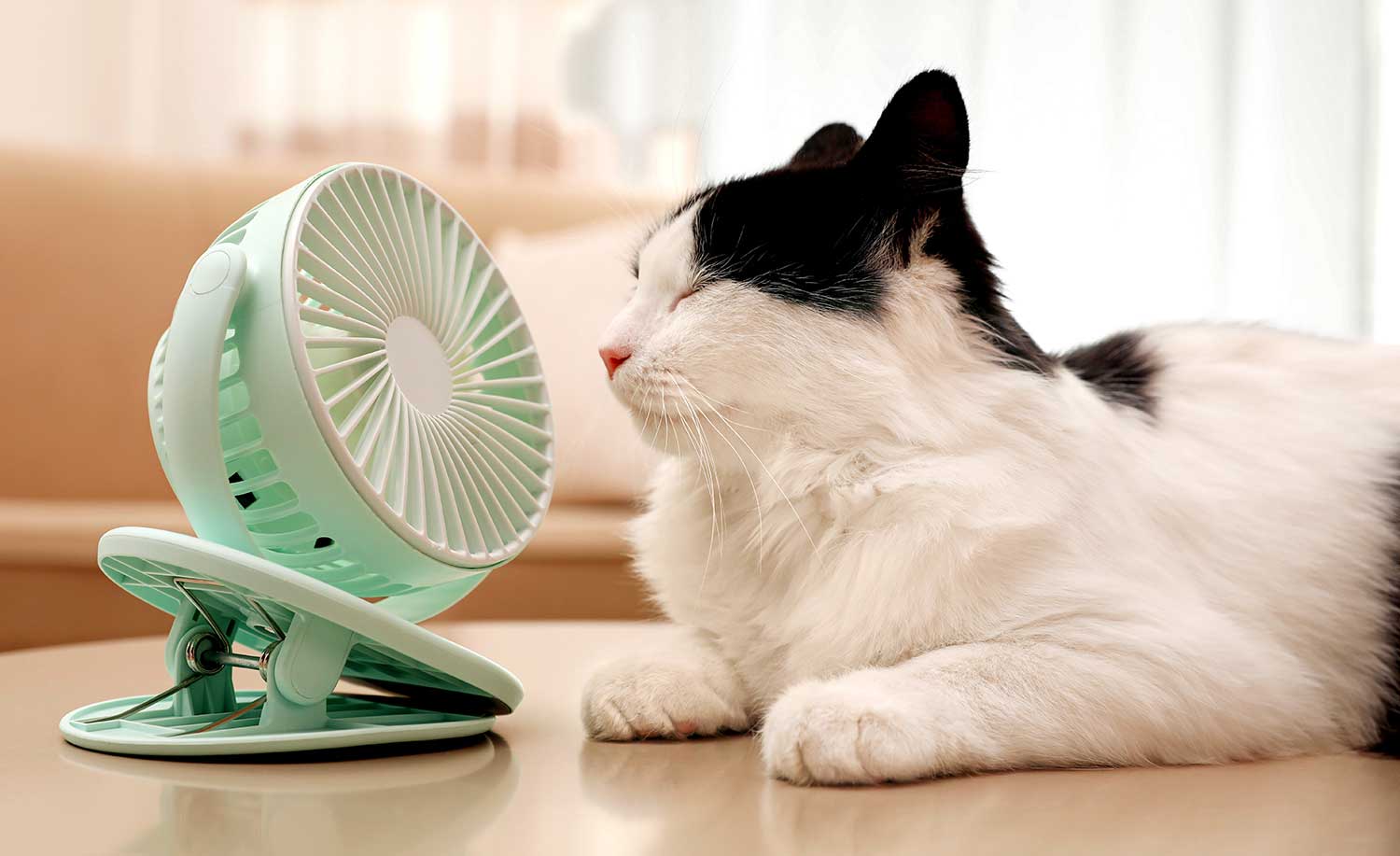
    • If it’s super hot, try putting a bowl of ice in front of a fan. This will create the effect of an air conditioner—until the ice melts!
    • Wear light-colored clothing. Like white paint, light-colored clothing will absorb less heat than dark clothing.
    • Turn down the air-conditioning. If you must use the air conditioner, try setting the thermostat (the part that determines the indoor temperature) one degree higher. This will save energy while still cooling you down.


    Remember, extreme heat can be dangerous, especially for the very young, older people, and pets. If the temperature is high, take it easy and drink plenty of water. And if you or family members need some relief, see if it’s possible to go to a store, a library, or another public place that’s air-conditioned.

How Sunlight Can Help

© deepblue4you—E+/Getty Images

Solar panels help capture the energy of the Sun.

Painting a building’s roof white deflects the Sun’s warming rays. But we can also harness the power of the Sun in a way that’s hugely helpful. Solar energy is less costly and less harmful to the planet than some other forms of energy, partly because the Sun’s energy is renewable, meaning it won’t run out.

You can learn more about solar energy at Britannica School.

WORD OF THE DAY

propitious

PART OF SPEECH:

adjective

Definition:

: likely to have or produce good results

Definitions provided by
Merriam-Webster Logo

Word Search

See if you can find all the treats that can keep you cool in the summer.

O
O
O
O
O
O

In Case You Missed It

The island of Corsica showed American colonists that a courageous revolution could defeat an empire.
May 7, 2026
Physicist Narinder Singh Kapany developed fiber optic cables, helping to make the Internet possible.
April 30, 2026
How can you tell whether photos and videos are real or made with AI? Here are a few tips.
April 24, 2026
A seemingly strange bank is saving one of Earth’s most valuable resources.
April 9, 2026