Home Run Kings
Aaron Judge and Albert Pujols brought baseball fans to their feet this past season with home run after home run.
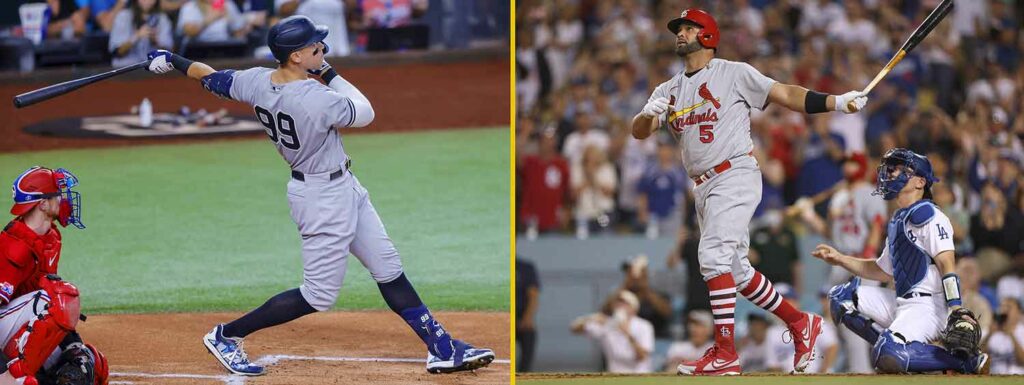
Harry How/Getty Images, Matt Pearce/UPI/Shutterstock; Composite Encyclopædia Britannica, Inc.
Side-by-side image shows Aaron Judge on the left and Albert Pujols on the right, both looking up just after batting.
It’s one thing to watch a YouTube video of a celebrated athlete whose career ended long ago. It’s another to witness legends in the making. Two Major League Baseball players racked up home run after home run before the regular season ended on October 5—making a strong case for legendary status.
On October 4, Aaron Judge of the New York Yankees hit his 62nd home run of the season during a game against the Texas Rangers. With that, Judge surpassed the record set by Roger Maris, who played for the Yankees in the 1960s, for the most single-season home runs in the American League. Only three players—Barry Bonds, Mark McGwire, and Sammy Sosa—got more home runs in a single season, and they all played in the National League.
Just a few days earlier, Judge had made headlines for home run number 61. The question of whether he would hit another home run hung in the air in the lead-up to the October 4 game. But Judge said he didn’t let the pressure get to him.
“I tried to enjoy every single moment,” Judge told MLB.com. “I didn’t think about, ‘Hey, they’re all on their feet to see you hit a home run.’ I tried to think about, ‘Hey, they’re here to see an exciting ballgame and see something special.’ Having that mindset helped me stay pretty calm, but there was definitely a little pressure in there.”
Amazingly, Judge isn’t the only home run king of the season. Albert Pujols of the St. Louis Cardinals hit his 703rd career home run on October 3. The achievement put Pujols fourth on the career home run list, behind Barry Bonds (762), Hank Aaron (755), and Babe Ruth (714). It was all the sweeter because Pujols will retire after this season.
Pitcher Jordan Montgomery was in a unique position to have witnessed both Judge’s and Pujols’s amazing seasons. Montgomery began the season with the Yankees and was later traded to the Cardinals. Speaking to MLB.com, Montgomery praised Judge and compared Pujols to baseball superstars of the past.
“[He’s like] Ted Williams, Hank Aaron, Babe Ruth, or Ty Cobb,” Montgomery marveled. “It’s stuff that you’re never going to hear about ever again.”
Did You Know?
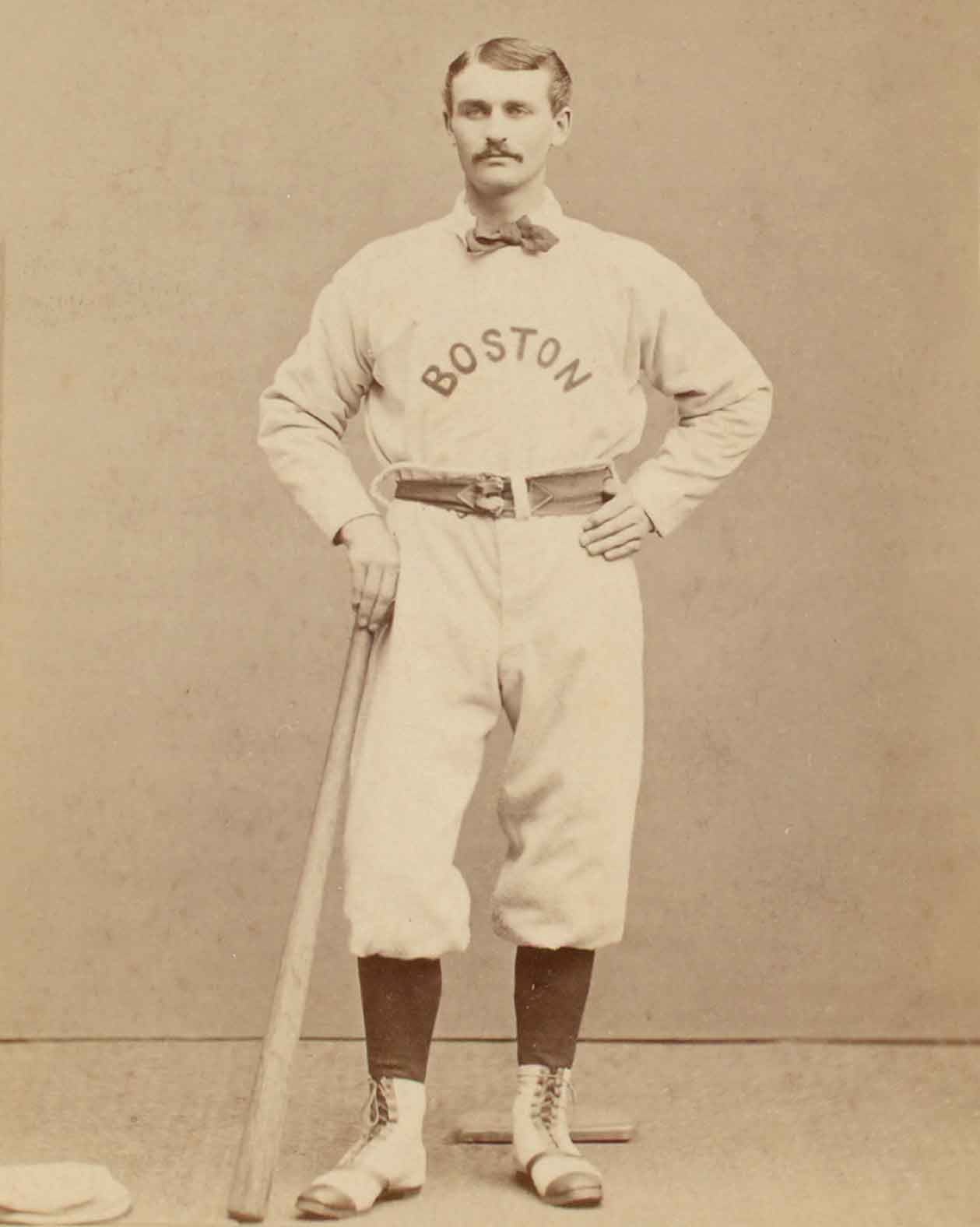
The Miriam and Ira D. Wallach Division of Art, Prints and Photographs: Photography Collection, The New York Public Library Digital Collections
Before there was Aaron Judge, there was Charles Roscoe Barnes.
Charles Roscoe Barnes hit the first home run in Major League Baseball history on May 2, 1876, at a field called Avenue Grounds in Cincinnati, Ohio. The ball went over the fence and, as a reporter wrote, “to the carriages.” (Remember, people drove carriages instead of cars back then.)
Are These Stats Legit?
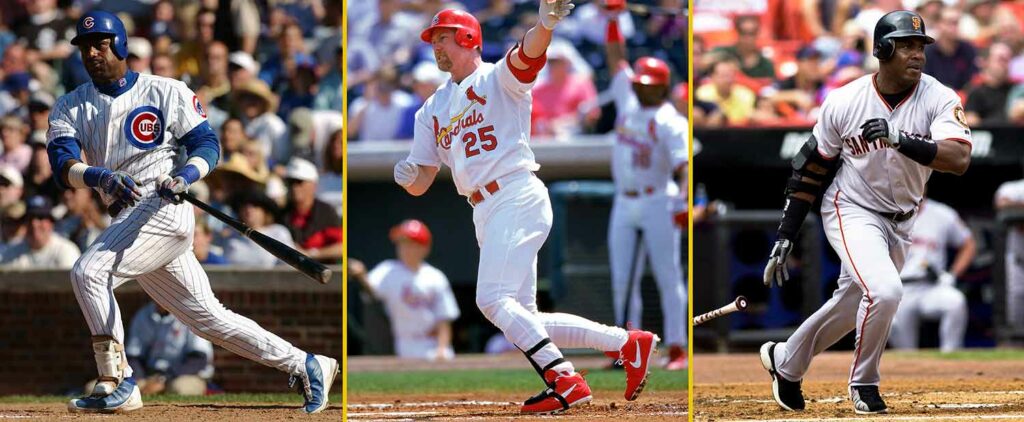
Jonathan Daniel/Getty Images Sport, Doug Pensinger/Getty Images Sport, © Jerry Coli/Dreamstime.com; Composite Encyclopædia Britannica, Inc.
When it comes to home runs, (left to right) Sammy Sosa, Mark McGwire, and Barry Bonds have the top spots in the record books.
Aaron Judge’s 62 single-season home run total put him ahead of Roger Maris in the record books. Three players achieved more single-season home runs than Judge. Sammy Sosa hit 66, Mark McGwire hit 70, and Barry Bonds holds the record, with 73. But some people, including Roger Maris’s son, argue that Sosa’s, McGwire’s, and Bonds’s stats aren’t legitimate.
The careers of Sosa, McGwire, and Bonds are mired in controversy over the use of steroids—drugs that can enhance strength. (Sosa has not admitted to using steroids, although it was reported that he tested positive on a drug test.) Steroids are illegal in Major League Baseball, and using them is considered cheating. Yet all three players are celebrated and listed in the record books.
Roger Maris Jr., the son of New York Yankee Roger Maris, says he believes Judge should be recognized as a true single-season home run king because he’s clean (drug-free).
“Not just for me,” Maris told reporters after Judge hit number 61. “I think it means a lot for a lot of people—that he’s clean, he’s a Yankee, he plays the game the right way…. He should be revered for being the actual single-season home run champ. I mean, that’s really who he is if he hits 62. I think that’s what needs to happen. I think [major league] baseball needs to look at the records and I think baseball should do something.”
Babe Ruth at Work
National Archives, Washington, D.C.
Babe Ruth was an early home run king. Check out the video to see Ruth doing what he did best.
Read about Babe Ruth at Britannica School!
WORD OF THE DAY
annals
noun
: historical records — usually used in the phrase “in the annals of”

Word Search
See if you can find all the baseball words and terms.
In Case You Missed It
NASA says a collision between a spacecraft and an asteroid went according to plan.
10.11.22
The Merriam-Webster dictionary added some new—and somewhat surprising—words to its pages.
09.30.22
The owner of Patagonia, an outdoor clothing company, is giving away the entire company.
09.27.22